
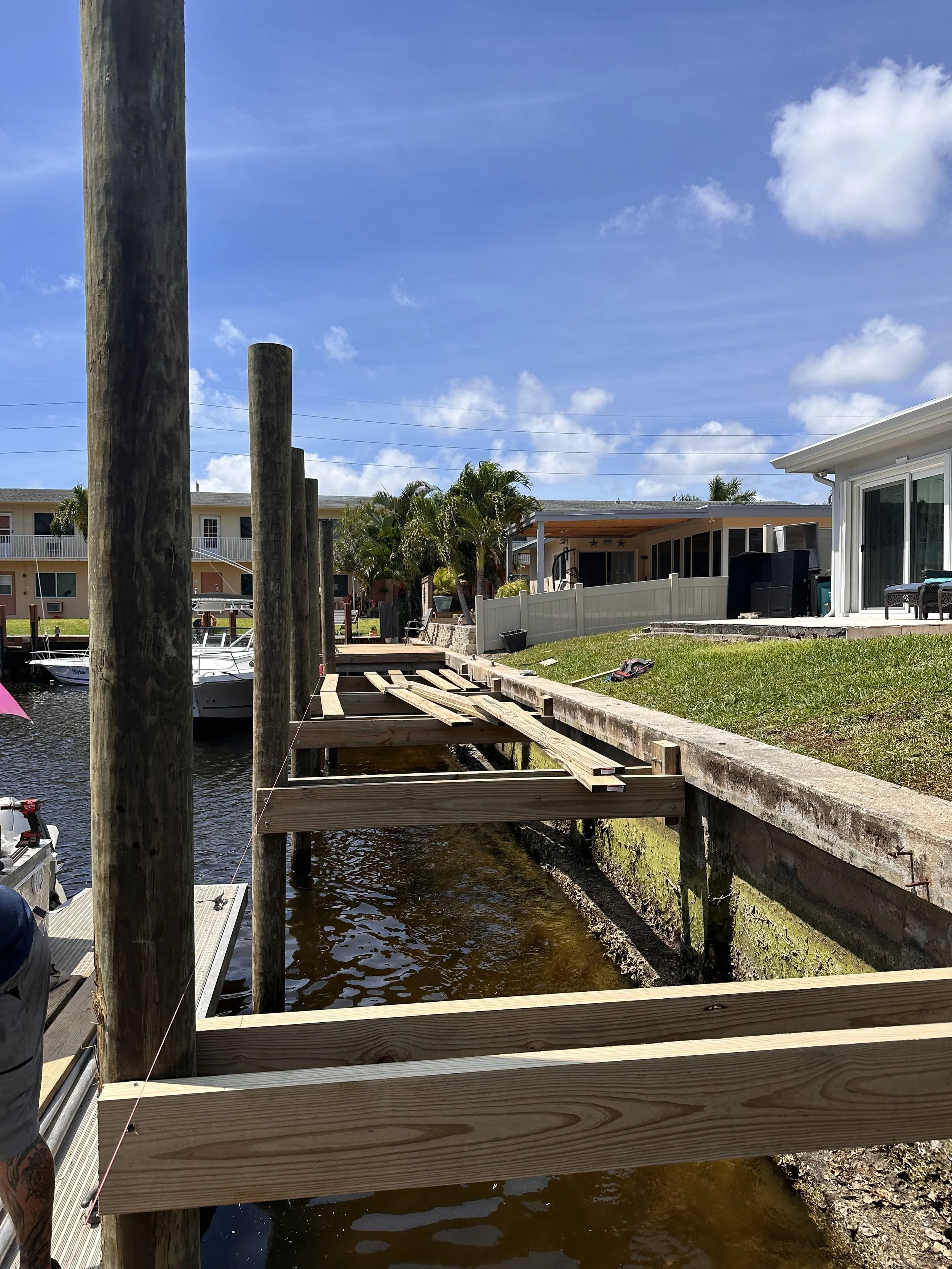
New marine pilings and dock framing being installed for a waterfront construction project in South Florida. Proper piling installation provides the structural foundation required to support docks, boat lifts, and other marine structures while withstanding harsh marine conditions.
If you are planning a new dock, replacing an aging one, or having a seawall repaired in South Florida, there is a good chance pile driving is part of the project. It is one of the most fundamental aspects of marine construction in Palm Beach County and Broward County — and one that most homeowners know very little about until they are about to have it done on their own property.
This guide explains what pile driving is, why it matters, what types of pilings are used in South Florida, and what the process looks like from a homeowner's perspective — from the JKT Marine Construction team.
What Is Pile Driving?
Pile driving is the process of installing vertical structural members — called pilings or piles — into the ground beneath a waterway or along a shoreline to provide the foundation support for docks, seawalls, and other waterfront structures.
In South Florida's marine construction environment, pilings are driven using either hydraulic vibratory hammers or impact hammers mounted on cranes — either from a barge positioned in the waterway, or from land-based equipment positioned along the shoreline depending on the site conditions and the type of piling being installed.
The depth to which pilings are driven — called embedment depth — is specified by a licensed marine engineer based on the soil conditions at your specific location, the load the piling needs to carry, and the waterway's tidal and wave energy environment. Getting the embedment depth right is critical. A piling driven too shallow will move under load. A piling driven to the correct depth will remain stable for the life of the structure it supports.
Types of Pilings Used in South Florida
Concrete Pilings — Best Overall for South Florida
Precast concrete pilings are the highest-performance piling material available for South Florida's marine environment and the most commonly specified by JKT Marine for new dock construction and seawall work.
Concrete pilings are manufactured off-site to engineered specifications and driven into position using crane-mounted equipment. They are heavy — which contributes to their structural stability once installed — and they require heavier equipment than wood or composite alternatives to handle and drive.
The performance advantages of concrete in South Florida are significant. Concrete does not corrode in saltwater. It is not susceptible to attack by marine boring organisms — the shipworms that attack wood pilings below the waterline in South Florida's waterways. It does not rot, does not require treatment, and does not degrade from UV exposure above the waterline.
Expected service life of a properly installed concrete piling in South Florida is 50 or more years. For permanent residential docks and seawalls on properties where longevity is the priority, concrete is JKT Marine's primary recommendation.
Composite and Fiberglass Pilings — Excellent Alternative
Composite and fiberglass pilings offer performance characteristics similar to concrete — no corrosion, no susceptibility to marine borers, and very long service life — in a lighter package that is easier to handle and install in some site conditions.
Composite pilings are increasingly specified throughout South Florida because their lighter weight compared to concrete allows installation in some situations where concrete's weight and the equipment required to handle it create access challenges. On narrow canals, sites with overhead obstacles, or locations where barge positioning is difficult, composite pilings can be the practical alternative that still delivers long-term performance.
Expected service life of quality composite pilings in South Florida is comparable to concrete — 40 to 60 or more years when properly installed.
Pressure-Treated Wood Pilings — Common But Shorter Lifespan
Pressure-treated timber pilings remain widely used in South Florida marine construction, particularly in budget-sensitive projects and applications where shorter replacement cycles are acceptable.
Wood pilings are lighter than concrete, easier to handle, and require less equipment to install — which contributes to their lower installed cost. The pressure treatment process uses preservatives designed to resist rot and marine boring organisms, but the protection is not absolute in South Florida's conditions. Shipworms — specifically the marine boring organisms that attack wood in South Florida's tidal waterways — can penetrate pressure-treated timber over time, particularly as the outer treatment layer degrades.
Expected service life of a pressure-treated timber piling in South Florida varies significantly by waterway conditions and the quality of the treatment. In typical canal conditions, 15 to 25 years is a reasonable expectation. In higher-exposure locations or waterways with more aggressive boring organism populations, service life may be shorter.
For homeowners who are replacing a dock that will be redecked again in 15 to 20 years anyway, pressure-treated timber pilings are a cost-effective choice. For homeowners building a dock they intend to own for 30 to 40 years without major structural work, concrete or composite pilings deliver better long-term economics despite their higher upfront cost.
What Does the Pile Driving Process Look Like?
From a homeowner's perspective, here is what to expect when pile driving is part of your dock or seawall project.
Equipment arrives first. Depending on the piling type and site conditions, this means either a barge positioned in the waterway with crane-mounted driving equipment, or land-based vibratory hammer equipment set up along the shoreline or dock. Concrete pilings typically require barge equipment. Composite and timber pilings can often be installed from the land side in accessible locations.
Pilings are positioned and driven. The crew positions each piling at the engineered location and drives it to the specified embedment depth. This process generates noise and vibration — the hammering or vibrating sound of pile driving carries throughout the immediate neighborhood. In South Florida's dense residential waterfront communities, neighbors are typically aware when pile driving is happening nearby. The duration depends on the number of pilings, the soil conditions, and the equipment being used — most residential dock piling installations are completed in one day.
Cutoff and finishing follows. After driving, pilings are cut to the correct height above the waterline for the dock or seawall cap that will be built on top of them. This is precision work — cut heights must be consistent and correct to ensure the dock surface is level.
For new dock construction, framing and decking follow after the pilings are installed and inspected. For seawall work, tieback installation and cap forming and pouring follow the pile driving phase.
How Deep Are Pilings Driven in South Florida?
This is one of the most common questions homeowners ask — and the honest answer is that it depends on the soil conditions at your specific location.
South Florida's geology varies significantly from one waterway to another and even from one property to the next. Some locations have soft muck sediment that requires driving pilings deeper to reach adequate bearing capacity. Others have hard limestone or compacted sand near the surface that provides good bearing at shallower depths. The variability is one of the reasons that a professional soil assessment and a licensed marine engineer's specification are part of every JKT Marine dock project.
Typical embedment depths for residential dock pilings in South Florida range from 8 to 20 feet below the mudline — meaning 8 to 20 feet of piling below the waterway bottom. This is in addition to the length of piling visible above the water surface. Total piling lengths of 25 to 40 feet or more are common for South Florida dock projects depending on water depth and required embedment.
Does Pile Driving Require a Permit in South Florida?
Yes. Pile driving for dock construction, seawall work, and dock replacement in South Florida requires permits from Palm Beach County or Broward County Building, SFWMD, and in many cases the Army Corps of Engineers.
JKT Marine manages all permitting for every project that includes pile driving. The permit applications identify the piling locations, materials, and embedment depths — and the permit inspection process verifies that pilings were installed to specification.
Why Pile Driving Quality Matters
Not all pile driving is done equally, and the differences matter for the long-term performance of your dock or seawall. Pilings driven to insufficient depth will move over time under load — causing structural problems with the dock or seawall built on them. Pilings that are not plumb — not vertical within acceptable tolerances — create geometry problems for the framing and decking built on top of them. Pilings cut to inconsistent heights above water create an unlevel structure that has to be shimmed and adjusted during framing.
JKT Marine's pile driving crew has extensive experience throughout Palm Beach County and Broward County's varied soil conditions. We drive pilings to the engineered specification on every project, verify plumb before moving on, and cut to consistent heights that make the subsequent construction accurate and straight.
Get a Free Consultation for Your Dock or Seawall Project
JKT Marine Construction handles full dock construction and replacement including all pile driving, framing, and decking throughout Palm Beach County, Broward County, and Martin County. All permits managed in-house. All work by our licensed crew.
Licensed CGC1537758. Fully insured. Family-owned. Free estimates at (561) 418-0383 or info@jktmarine.com.
Frequently Asked Questions
How long does pile driving take for a residential dock in South Florida? Most residential dock pile driving is completed in one day. Larger projects with more pilings or challenging site conditions may take two days. The full dock construction including framing and decking follows after pile driving is complete.
How noisy is pile driving? Pile driving is the noisiest part of any dock or seawall construction project. Vibratory hammer equipment generates significant noise that carries through the waterway neighborhood during the driving phase. Most residential piling installations in South Florida are completed in a single day of driving — the noise is temporary but noticeable. JKT Marine is transparent about this with both clients and neighbors.
How do I know what type of piling is right for my dock? The right piling depends on your budget, the expected service life of your dock, your waterway conditions, and site access for equipment. JKT Marine evaluates all of these factors during the free site assessment and recommends the piling type that best matches your specific situation.
What happens if a piling hits an obstruction during installation? Underground obstructions — old pilings, debris, coral, or hard limestone — occasionally occur in South Florida's waterways and can complicate pile installation. When our crew encounters an obstruction, we assess whether it can be driven through, whether the piling location needs to be adjusted, or whether a different installation approach is needed. We communicate any obstruction situation to you directly and do not proceed with a solution that changes the project scope without your agreement.