
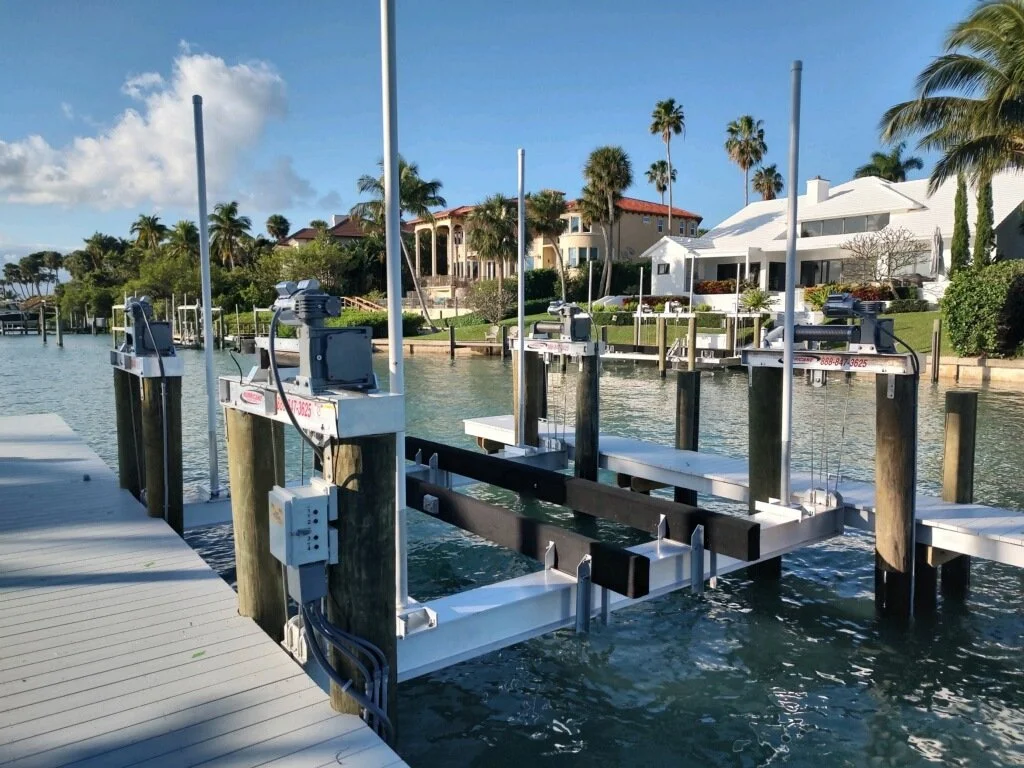
Proper boat lift preparation before hurricane season can help protect vessels, docks, and waterfront infrastructure from storm-related damage. South Florida homeowners should inspect boat lifts, electrical systems, cables, pilings, and dock hardware before severe weather arrives.
Hurricane season in South Florida runs June 1 through November 30. For waterfront homeowners throughout Palm Beach County and Broward County who own boats, that six-month window requires advance planning — not reactive decision-making when a storm is already in the forecast. The decisions you make before a storm threatens your area are more important than anything you can do once a watch or warning is issued.
At JKT Marine Construction we work with South Florida waterfront homeowners on both sides of every storm season — preparing docks, seawalls, and boat lifts before it begins and repairing storm damage after it ends. Here is what our ownership team recommends for protecting your boat and your waterfront investment through South Florida's hurricane season.
Before Hurricane Season: Preparation That Happens in the Spring
The most effective hurricane preparation for South Florida boat owners happens in March, April, and May — not when storm forecasts are already on the news. Here is what to do before June 1.
Inspect your boat lift thoroughly or have it professionally serviced. A lift that is functioning marginally in May is a lift that may fail at the worst possible moment — when you need to rapidly lower your boat to trailer it ahead of an approaching storm, or when you want your boat elevated above surge level during a minor event. Annual professional lift service in the spring gives you confidence in your equipment before the season opens. JKT Marine offers annual lift service throughout Palm Beach and Broward County — call us in March or April and we will assess your lift, lubricate cables, test the motor, and identify any components that need attention before the season.
Inspect your dock and seawall and address any developing problems. A dock with soft spots, rotting boards, or structural concerns is a dock that storm surge and wave action will exploit. A seawall with developing cracks or blocked drainage is a seawall that surge loading will stress more severely than a well-maintained wall. Pre-season professional assessment from JKT Marine is free — and any repair identified is far easier and less expensive to address before a storm than after.
Create and document your storm plan. Know in advance what category storm triggers each level of your response — what you do differently for a tropical storm versus a Category 1 versus a Category 3. Having a documented plan means you make rational decisions in advance rather than emotional decisions under time pressure when a storm is in the forecast.
Assemble emergency contacts. Know your marina's storm policies if applicable. Have your insurance agent's contact and your policy number accessible. Know which local marine contractors provide emergency repair services — JKT Marine provides post-storm emergency service throughout Palm Beach and Broward County.
Know Your Options When a Storm Is Forecast
When a storm system enters the Gulf of Mexico or Atlantic and forecasters identify a potential threat to South Florida, you have options — and the right option depends on the storm's expected intensity and your specific situation.
Leave your boat on the lift for a tropical storm or weak Category 1. A properly maintained boat lift in good structural condition is designed to handle South Florida's normal tidal range and moderate wave conditions. For minor storm events, leaving your boat on the lift — fully elevated, properly secured with additional lines — is often the right choice. Remove canvas, bimini tops, t-tops if possible, and any removable equipment that could become a sail or projectile in wind.
Trailer your boat for Category 2 and above. If you have a trailerable boat — generally anything under 35 feet depending on your tow vehicle and trailer — getting your boat out of the water and to higher ground away from coastal surge zones is the most effective storm protection available. This requires having your trailer in proper working condition, your tow vehicle fueled and ready, and a destination identified before the storm is close enough to create gas station lines and traffic.
Dry storage is the gold standard for larger vessels. If your boat is too large to trailer, a permitted dry storage facility that elevates boats on racks above expected surge levels provides much better protection than leaving a vessel in a wet slip or on a lift. Many South Florida dry storage facilities fill up as storm threats develop — having an established relationship with a facility and understanding their storm procedures before the season is important.
Wet slip in a protected location with proper preparation is a last resort for larger vessels that cannot be trailered or dry-stored. If your boat stays in the water, remove canvas and removable gear, use additional dock lines — doubling or tripling your normal configuration — and position your vessel to minimize swing that could cause it to contact the dock, a piling, or another vessel.
What Never Works: Common Mistakes That Cause Preventable Damage
Leaving canvas up during a storm. Biminis, cockpit covers, and t-tops act as sails in hurricane-force winds. A bimini that survives 10 years of South Florida summers will not survive 100+ mph winds. Remove every piece of canvas from your boat before a storm arrives.
Leaving your boat on a lift during a major hurricane. A boat lift is designed for normal tidal conditions — not for the 5-to-10 foot or greater surge that a major hurricane delivers to South Florida's coastal waterways. A boat left on a lift during a major hurricane in a surge zone faces significant risk of the lift failing under surge loads, the boat floating off the bunks and swinging into structures, or the dock itself failing. For Category 3 and above events affecting your area, remove your boat from the lift.
Waiting too long to make a decision. South Florida's fuel stations, boat ramps, and marina facilities experience dramatic demand surges as storm threats develop. Homeowners who begin their storm preparation 48 to 72 hours before landfall have options. Those who wait until 24 hours before may not. Watch the forecasts early, make decisions early, and execute your plan with margin.
Using inadequate dock lines. A boat that breaks free from its dock during a storm becomes a hazard to itself, to other vessels, and to docks and seawalls throughout the waterway. If your boat is staying in the water, use heavy-gauge dock lines, double or triple your normal line count, and use chafe protection where lines contact dock hardware.
After the Storm: Inspection Before You Use Anything
After any significant storm event passes your area, inspect your dock, lift, and seawall thoroughly before using any of them or putting your boat back in the water.
Look for dock boards that are cracked, shifted, or missing. Look for pilings that have moved position or show impact damage. Look for lift components that have shifted, cable damage, or structural frame damage. Look for seawall cap sections that have moved or cracked, new cracks in panels, or soil erosion behind the wall.
Do not put your boat back on a lift that shows storm damage without having it professionally inspected first. A lift component that looks intact but was stressed by surge loading can fail under normal use conditions after a storm.
JKT Marine provides free post-storm assessments throughout Palm Beach County and Broward County after significant weather events. We assess docks, lifts, and seawalls and provide complete repair quotes for whatever storm damage we find.
Insurance Documentation After a Storm
Document all storm damage with dated photographs before any temporary repairs are made — even emergency repairs. Your insurance claim will be more effectively supported by evidence of the condition immediately after the storm than by photographs taken after temporary work has already been done.
JKT Marine provides detailed written damage assessments with photographs for insurance purposes on every storm damage project. Many Palm Beach County homeowners have used our assessment documentation successfully in property and flood insurance claims following storm events.
JKT Marine Hurricane Season Services
JKT Marine Construction provides pre-season dock, lift, and seawall inspections and maintenance throughout Palm Beach County, Broward County, and Martin County. We provide emerge