
How to Prepare Your Seawall for Hurricane Season in South Florida
Hurricane season runs June 1 through November 30 in South Florida — and for waterfront homeowners throughout Palm Beach County, Broward County, and Martin County, that six-month window is when your seawall matters most.
How to Prepare Your Seawall for Hurricane Season in South Florida
Hurricane season runs June 1 through November 30 in South Florida — and for waterfront homeowners throughout Palm Beach County, Broward County, and Martin County, that six-month window is when your seawall matters most. A properly maintained seawall in sound structural condition is one of the most important storm protection elements on any waterfront property. A seawall with developing problems — cracks, cap deterioration, blocked drainage, or early structural compromise — can fail when a storm event exposes those weaknesses to surge conditions that normal tidal and wake loads simply do not generate.
The time to assess and address seawall problems is before hurricane season — not during it, and certainly not after a storm has found the weak points your wall was hiding. Licensed marine contractors, materials, and permit processing are all more accessible before the season than in the competitive post-storm rush that follows every significant weather event in South Florida. This guide covers exactly what to do before the season, during a storm, and in the critical 48 to 72 hours after a storm passes.
Before Hurricane Season: 5 Steps Every South Florida Waterfront Homeowner Should Take
Step 1 — Schedule a professional seawall inspection before June 1
The single most important hurricane preparation step for a South Florida waterfront property owner is a professional seawall inspection completed before storm season opens. JKT Marine's free inspections are available throughout Palm Beach County, Broward County, and Martin County year-round — but the pre-season window of March through May gives you the maximum time to address any identified problems before the first storm threat of the season arrives.
Step 2 — Address any identified repairs before the season opens
If your pre-season inspection identifies developing problems — cap deterioration, early structural cracking, blocked drainage, corroded tieback indicators, or soil erosion — address them before storm season begins, not after. Structural problems in a seawall are amplified by storm conditions. A wall with a developing lean that holds under normal tidal and wake conditions can fail under the lateral loading of storm surge. Cap sections that are cracked but still in position can be completely dislodged by hurricane-force waves. JKT Marine prioritizes pre-season repair work specifically because we understand what storm conditions reveal about seawalls with developing problems.
Step 3 — Clear all seawall drainage systems
Blocked weep holes and drainage points are a routine maintenance issue under normal conditions. During storm surge, they become a structural hazard. When surge overtops a seawall and water cannot drain back through properly functioning drainage points, hydrostatic pressure builds rapidly on the inland side of the wall — dramatically increasing the lateral load the wall must resist at the exact moment it is under its greatest storm stress. Drainage clearing is included in every JKT Marine pre-season maintenance visit.
Step 4 — Document your seawall's current condition with dated photographs
Before storm season, photograph the full length of your seawall — the cap surface, both faces where visible, the yard area behind the wall, and any existing cracks or conditions you are already aware of. This documentation establishes a baseline that allows you to accurately identify storm-related damage after an event. It also provides evidence of pre-storm condition for insurance claims in the event a storm causes damage to your seawall or the property behind it.
Step 5 — Verify your seawall cap elevation meets current county standards
Palm Beach County and Broward County both maintain minimum seawall cap elevation requirements. Properties where the cap does not meet current standards face greater risk of storm surge overtopping — which increases the hydrostatic force acting on the inland side of the wall during surge conditions. If your seawall cap is below current county elevation standards, cap raising before hurricane season is a meaningful risk reduction step that also satisfies lender and insurance requirements that are increasingly applied to waterfront properties in flood risk zones.
During an Active Storm: What Seawall Owners Should Know
Your seawall is designed to do its job without any action from you during a storm event. Do not attempt to inspect, access, or modify your seawall while a storm is active. Storm surge, high winds, and waterborne debris make waterfront areas dangerous during active weather, and nothing you can do during a storm improves a seawall's performance.
The one meaningful action to take before a storm arrives — not during it — is removing all dock-mounted equipment, mooring lines, fender systems, dock boxes, and loose items from the dock and seawall area. These items can become dangerous projectiles in high winds and can snag during surge, transmitting additional unexpected load to dock and seawall hardware at the worst possible time.
After a Storm: What to Inspect in the First 72 Hours
The 48 to 72 hours after a significant weather event passes are the most important window for identifying storm-related seawall damage — and for documenting it while conditions are still fresh. As soon as it is safe to be at the waterfront, walk the full length of your seawall and look for the following.
New cracks or widened existing cracks on the panel face or cap. Any crack that was not present before the storm or that appears meaningfully wider than before indicates storm-related structural stress worth having professionally evaluated.
Any visible shift in wall position or alignment compared to pre-storm photographs. Even subtle changes in lean, panel alignment, or cap position can indicate storm-related structural movement that warrants professional assessment.
New soft spots, depressions, or settled areas in the yard behind the wall. Storm surge can create or dramatically expand soil voids behind a seawall in a single event. New depressions or settling in the yard near the seawall are a post-storm inspection priority.
Debris embedded against or in the seawall face. Debris impact from storm surge can damage caps and panels in ways not immediately visible from a distance. Once debris is carefully cleared, inspect the wall face underneath for impact damage.
New or worsened rust staining. Storm surge stress can accelerate internal rebar corrosion failure to the point of producing new surface staining that was not visible before the storm.
Changes in drainage behavior. If water that normally drained efficiently behind the wall is now ponding or draining more slowly, storm debris may have blocked drainage points that need to be cleared before the next tidal cycle.
An important note: not all storm-related seawall damage is visible from the property surface. If your property experienced significant surge during a named storm event, call JKT Marine for a free post-storm professional inspection even if nothing appears obviously wrong from the dock.
JKT Marine's Hurricane Season Services
JKT Marine provides the following services for South Florida waterfront homeowners related to hurricane season preparation and storm response throughout Palm Beach County, Broward County, and Martin County.
Free pre-season seawall inspections — structural assessment with written report, prioritized repair recommendations, and a clear picture of your wall's condition heading into storm season.
Pre-season maintenance and repair — drainage clearing, crack sealing, concrete sealing, and structural repairs scheduled for completion before June 1 while scheduling and materials are readily available.
Free post-storm inspections — structural assessments after any named storm or significant weather event, available throughout our three-county service area.
Emergency post-storm repair services — when storm damage is identified, JKT Marine prioritizes emergency structural repairs to prevent storm-damaged seawalls from experiencing further failure through the remainder of the storm season.
The best time to call about your seawall and the upcoming hurricane season is right now — before June 1, while scheduling is flexible and while any work identified has time to be completed before the first storm threat arrives.
Call (561) 418-0383 or email info@jktmarine.com.
JKT Marine Construction — Licensed CGC1537758 · Fully Insured · Family-Owned · All Permits Handled · Serving Palm Beach County, Broward County & Martin County
New Seawall Installation Cost in Palm Beach County — 2026 Guide
Every number in this guide comes directly from JKT Marine Construction's project experience throughout Palm Beach County in 2025 and 2026. These are real installed costs from actual projects — not manufacturer estimates, not national averages from home improvement websites, and not ballpark figures padded for unknown conditions.
New Seawall Installation Cost in Palm Beach County — 2026 Guide
You already have a resource on this site covering seawall repair costs. This guide is different — it covers the cost of a brand-new seawall installation from the ground up. Whether you are building on a vacant waterfront lot, replacing a wall that has reached structural end of life, or putting in a first seawall on a property that never had one, the cost drivers are meaningfully different from a repair project and the figures in repair cost guides do not apply.
Every number in this guide comes directly from JKT Marine Construction's project experience throughout Palm Beach County in 2025 and 2026. These are real installed costs from actual projects — not manufacturer estimates, not national averages from home improvement websites, and not ballpark figures padded for unknown conditions.
What a Complete New Seawall Installation Cost Includes
Before the numbers, it is important to understand what a complete, fully installed seawall cost actually covers. The gap between a low quote and a complete quote in Palm Beach County's marine construction market can be tens of thousands of dollars.
A fully installed new seawall in Palm Beach County from JKT Marine includes engineering coordination with a licensed marine engineer. It includes all permit application preparation and fees — Palm Beach County Building, SFWMD, FDEP, and Army Corps of Engineers where applicable. It includes equipment mobilization and barge costs where required. It includes seawall panel material — vinyl sheet pile, precast concrete, or composite depending on your waterway and site. It includes panel installation to the engineered embedment depth. It includes tieback rod and deadman anchor installation. It includes concrete cap forming and pouring to current county elevation standards. It includes drainage system installation. It includes final county inspection coordination and site cleanup and restoration.
Every one of these components is included in every JKT Marine quote before you sign. There are no change orders for permits that turned out to be required. There are no line items added after the contract for engineering that was always going to be needed. The price you receive before signing is the price you pay.
New Seawall Installation Cost by Material — Palm Beach County 2026
Vinyl Sheet Pile Seawall
Vinyl sheet pile is the most frequently installed seawall material on residential canal properties throughout Palm Beach County and the most competitively priced for protected canal applications where structural mass is not the primary engineering requirement.
Typical installed cost: $350 to $550 per linear foot.
A typical 80-foot residential canal seawall in Palm Beach County in vinyl sheet pile — including engineering, permitting, panels, tieback system, and concrete cap — runs $28,000 to $44,000 fully installed. A 100-foot wall runs $35,000 to $55,000.
Precast Concrete Seawall
Concrete seawall installation carries a higher cost than vinyl for equivalent wall lengths — reflecting greater material weight, the barge and crane equipment typically required, and the more complex panel handling logistics involved.
Typical installed cost: $450 to $700 per linear foot for standard residential applications. $600 to $900 per linear foot for Intracoastal Waterway and deep water installations where barge positioning and extended embedment depth requirements add to equipment and material costs.
A typical 80-foot concrete seawall on the Intracoastal in Palm Beach County runs $48,000 to $72,000 fully installed — with the higher end reflecting properties where water depth, site access, or Army Corps of Engineers permitting add to the overall project scope.
Composite Seawall Systems
Composite systems — combining vinyl sheet piling with enhanced concrete cap work and superior tieback configurations — fall between vinyl and standard concrete on cost and deliver the longest expected service life of the three material options.
Typical installed cost: $500 to $800 per linear foot.
A typical 80-foot composite seawall installation in Palm Beach County runs $40,000 to $64,000 fully installed.
What Drives Cost Up — and What Keeps It Down
Understanding what pushes new seawall installation cost higher or lower helps Palm Beach County waterfront homeowners evaluate quotes intelligently before committing to a project.
Water depth increases cost. Deeper waterways require panels driven to greater embedment depths — using more material and more drive time. Intracoastal Waterway properties in Palm Beach County typically have greater water depth than interior residential canals, which directly contributes to their higher installed cost per linear foot.
Barge requirement increases cost. Vinyl seawalls on many residential canals can be installed entirely from the land side without a barge. Any project requiring barge positioning adds mobilization, barge day rate, and marine crew costs that can add $5,000 to $20,000 to the overall project cost depending on duration and vessel size required.
Existing wall demolition increases cost. If you are replacing an existing seawall, removing and disposing of old panels, cap, and hardware adds $5,000 to $20,000 depending on wall length and what the existing structure is made of.
Army Corps permitting increases cost and timeline. Intracoastal and navigable waterway projects requiring Army Corps of Engineers authorization carry higher permitting fees and longer permit timelines than standard canal projects.
Land-side installation reduces cost. When vinyl sheet pile can be installed using land-based vibratory hammer equipment without a barge — which is possible on many Palm Beach County residential canal properties — installation costs are meaningfully lower than for projects requiring water-based equipment access.
Longer walls reduce cost per foot. Mobilization, permitting, and engineering costs are relatively fixed regardless of wall length. Longer walls spread these fixed costs across more linear feet, reducing the per-foot installed cost on larger projects.
A Note on Quotes Significantly Below These Ranges
Every year JKT Marine meets Palm Beach County waterfront homeowners who received quotes dramatically below the ranges in this guide. Some of these low quotes reflect genuinely different work — quotes that exclude engineering, use below-spec materials, skip required permits, or do not include the tieback and anchor system the wall actually needs to perform structurally over time. Others reflect contractors who add those costs back in change orders after the contract is signed.
A complete, honest new seawall installation quote for Palm Beach County in 2026 falls within the ranges in this guide. Quotes significantly below these numbers warrant careful scrutiny of exactly what is included — and what is not.
Get a Free On-Site Estimate for Your Seawall Project
The most reliable way to understand what your specific new seawall installation will cost is a free on-site assessment from JKT Marine's ownership team. We visit your property, evaluate your waterway conditions and site access, and provide a complete line-item quote with no hidden components and no changes after you sign.
Call (561) 418-0383 or email info@jktmarine.com.
JKT Marine Construction — Licensed CGC1537758 · Fully Insured · Family-Owned · All Permits Handled · Serving Palm Beach County, Broward County & Martin County
Seawall Repair vs Full Replacement — How to Know Which One You Need
When a South Florida waterfront homeowner discovers seawall damage, the first question is almost always the same one — do I need to repair this or replace the entire wall?
Seawall Repair vs Full Replacement — How to Know Which One You Need
When a South Florida waterfront homeowner discovers seawall damage, the first question is almost always the same one — do I need to repair this or replace the entire wall? The answer to that question determines whether you are looking at a $5,000 to $25,000 repair or a $40,000 to $100,000 replacement project. Getting it right — choosing repair when repair is the honest answer and replacing when replacement is genuinely necessary — is one of the most significant financial decisions a waterfront property owner in Palm Beach or Broward County will face.
Here is exactly how JKT Marine's ownership team approaches this evaluation on every seawall assessment throughout South Florida.
Why Surface Appearance Cannot Tell You the Answer
Seawall condition is not always apparent from what you can see. A wall that looks alarming — with surface rust staining, visible cap cracks, and a weathered appearance — may have an underlying panel structure that is still structurally sound and capable of delivering another 15 to 20 years of service life with the right targeted repairs. A wall that looks passable from the dock may have severely corroded internal tie rods and rebar that are invisible from the surface but that make the wall a replacement candidate.
This is why a professional structural assessment by a licensed marine contractor is the essential first step before any repair versus replacement decision. Surface appearance simply cannot substitute for hands-on professional evaluation of the components that actually determine a seawall's structural fate.
When Repair or Restoration Is the Right Answer
Several conditions consistently point toward repair or restoration rather than full replacement in JKT Marine's field experience throughout Palm Beach and Broward County.
The underlying panel structure is sound. This is the single most important factor in the entire evaluation. If the seawall panels — the structural elements that actually retain the soil and resist water pressure — are intact, properly aligned, and free of structural cracking, the wall has a foundation worth investing in. Problems with the cap, the tieback system, the drainage, or the surface concrete can all be addressed through targeted work while leaving the sound panel structure in place.
Damage is localized rather than widespread. A wall where specific sections have failed while others remain in good condition is a strong repair candidate. JKT Marine addresses the failed sections without touching the portions of the wall that are still performing — a cost-effective approach that is not possible when damage is distributed throughout the wall length.
The wall is under 30 years old with identifiable specific problems. Age alone does not determine repair versus replacement — but walls under 30 years old with specific, identifiable damage almost always benefit from repair rather than replacement because the core structure still has significant design life remaining when problems are correctly addressed.
Repair cost is below 50 to 60 percent of replacement cost. This is a general financial threshold JKT Marine uses in evaluations. When repairing a seawall costs less than roughly half of what replacing it would cost — and the repairs actually address the structural problems rather than just treating symptoms — repair is almost always the better financial decision.
When Full Replacement Is the Right Answer
Other conditions consistently indicate that full replacement is the honest recommendation — even though it is the more expensive one.
Structural failure is distributed throughout the wall length. When horizontal cracking, panel displacement, or significant structural deterioration is spread throughout the wall rather than concentrated in specific sections, the entire panel system is compromised. Repairing individual sections of a wall with widespread structural failure addresses symptoms without solving the underlying condition.
Internal rebar corrosion is pervasive and deep. Surface rust staining on an otherwise sound wall is an early-stage indicator that targeted repair can often address. Rust staining that is widespread across the full wall length, accompanied by spalling and concrete loss throughout, indicates corrosion that has compromised the structural capacity of the concrete panels themselves — a condition that repair cannot reverse.
The wall is at or beyond its design service life with widespread deterioration. Many concrete seawalls in Palm Beach and Broward County that were installed in the 1970s and 1980s are now 45 to 55 years old. When a wall of this age has widespread structural deterioration — not just surface wear but actual structural loss throughout — replacement is frequently both the honest recommendation and the more cost-effective long-term answer.
Repair cost exceeds 70 percent of replacement cost. When the scope of structural repairs needed to address a wall's actual problems approaches the cost of a new wall, the calculus shifts toward replacement. A heavily repaired aging wall is still an aging wall — replacement delivers a new structure with a full design service life from installation day.
The wall has experienced structural collapse in sections. Collapsed panels, sections of wall that have fallen into the canal, or walls that are leaning to the degree that they pose imminent risk of failure are clearly replacement situations. There is no repair pathway for a wall that has already failed structurally in multiple locations.
What JKT Marine Evaluates During Every Assessment
JKT Marine conducts every free seawall assessment with one objective — to give the homeowner the honest answer about their specific wall, not the answer that generates the larger project. Our ownership team has no structural incentive to recommend replacement when repair is appropriate. Our reputation throughout Palm Beach and Broward County is built on homeowners who trusted our assessment and felt that trust was justified.
During every assessment, we evaluate the panel structural integrity — alignment, cracking patterns, and evidence of bending or displacement. We assess the cap condition including cracking extent, rebar corrosion indicators, and elevation versus current county standards. We examine tie rod indicators on the surface that suggest corrosion or elongation behind the wall. We check drainage system function and identify blocked or missing weep holes. We assess the soil condition directly behind the wall for erosion indicators and void formation evidence. And we account for the wall's overall age and any available permit or repair history.
After completing this evaluation, we give you a direct written recommendation — repair this, consider restoration, or replace this — with the reasoning explained clearly and a line-item cost estimate for the recommended path.
That assessment is free. The decision is always yours.
Get a Definitive Answer — Free On-Site Assessment
Stop guessing whether your South Florida seawall needs repair or replacement. JKT Marine's ownership team visits your property, evaluates your wall in person, and delivers a documented recommendation with a complete cost estimate and no obligation to commit.
Call (561) 418-0383 or email info@jktmarine.com.
JKT Marine Construction — Licensed CGC1537758 · Fully Insured · Family-Owned · Serving Palm Beach County, Broward County & Martin County · All Permits Handled
Do I Need a Permit to Repair or Replace My Seawall in Florida?
One of the first questions South Florida waterfront homeowners ask when they discover a seawall problem is a practical one — do I actually need a permit for this? The answer depends on what type of work is being done, which waterway your property sits on, and which county and agencies have jurisdiction over your shoreline.
Do I Need a Permit to Repair or Replace My Seawall in Florida?
One of the first questions South Florida waterfront homeowners ask when they discover a seawall problem is a practical one — do I actually need a permit for this? The answer depends on what type of work is being done, which waterway your property sits on, and which county and agencies have jurisdiction over your shoreline. Getting this wrong — either skipping a permit that was required or being misled about what is actually needed — can cost significantly more than the permit itself.
At JKT Marine Construction, we manage all permitting for every seawall project we undertake throughout Palm Beach County, Broward County, and Martin County. Here is exactly what the permitting landscape looks like for South Florida seawall work in 2026.
The Short Answer: Major Seawall Work Always Requires Permits in Florida
If your project involves any of the following, permits are required with no exceptions.
New seawall installation of any material or length. Full seawall replacement — removing and rebuilding the wall. Seawall cap replacement or cap raising to meet current elevation standards. Supplemental tieback installation. Any structural work on a wall adjacent to a navigable waterway. Any change to the existing seawall's footprint, height, or alignment.
The only seawall work that typically does not require permits is minor surface maintenance — pressure washing, marine-grade concrete sealing, hairline crack sealing with surface-applied sealant, and weep hole clearing. These are maintenance activities, not structural modifications, and they fall below the threshold that triggers permit requirements in Palm Beach County and Broward County.
If you are unsure whether your specific situation requires a permit, call JKT Marine at (561) 418-0383 before starting any work. We identify exactly what your project requires during the free site assessment.
Which Agencies Are Involved in South Florida Seawall Permits
Seawall permits in South Florida are not a single-agency process. Depending on your waterway and project scope, you may need approvals from several agencies simultaneously. Here is who is involved and why.
County Building Department: The baseline permit that applies to virtually all structural seawall work in South Florida. Palm Beach County Building, Broward County Building, or Martin County Building depending on your location. Every structural seawall project starts here.
City Building Department: For properties within incorporated cities — West Palm Beach, Boca Raton, Fort Lauderdale, Jupiter, Lantana, and dozens of others — the city's own building department may have jurisdiction instead of or alongside the county. JKT Marine identifies the correct jurisdictional authority for every project during your free assessment.
South Florida Water Management District (SFWMD): Environmental Resource Permits are required for work in or over state waters — which includes the vast majority of South Florida's tidal canals, the Intracoastal Waterway, and all navigable waterways. Required on virtually every tidal seawall project throughout our service area.
Florida Department of Environmental Protection (FDEP): FDEP involvement becomes more significant on ecologically sensitive waterways — particularly the St. Lucie River, the Indian River Lagoon, and the Loxahatchee River. For most standard Palm Beach and Broward County canal projects, FDEP review is handled through the SFWMD process.
Army Corps of Engineers: Required for work on navigable waterways — including the Intracoastal Waterway and its connected systems throughout Palm Beach and Broward County. Army Corps review most often extends the overall timeline for Intracoastal seawall projects beyond what interior canal projects require.
Florida Fish and Wildlife Conservation Commission: Required in specific situations involving protected species habitat, particularly in Martin County near designated manatee protection zones and in areas with documented marine habitat sensitivity.
How Long Does Seawall Permitting Take in South Florida
Permitting timelines are one of the most common sources of frustration for waterfront homeowners. The timelines below reflect JKT Marine's actual permit experience throughout our service area in 2025 and 2026 — not optimistic estimates designed to win projects.
Standard residential canal seawall: 4 to 8 weeks from application submission through permit issuance. These projects typically involve county building and SFWMD permits only and move through agencies most efficiently.
Intracoastal Waterway seawall: 6 to 12 weeks. Army Corps of Engineers review adds time beyond the county and SFWMD process. The Corps review period varies based on their current workload and the scope of the specific project.
St. Lucie River and Martin County ecologically sensitive waterways: 12 to 24 weeks or more. FDEP Environmental Resource Permitting on the St. Lucie River involves the most detailed environmental review process in our service area and cannot be accelerated in the way that standard canal permits sometimes can.
JKT Marine submits all permit applications the moment your project is confirmed — we never hold permit filings while waiting on other details to be resolved. Every week of delay in submitting permits is a week added to the overall timeline that the homeowner carries.
What Happens If You Skip a Required Permit
Unpermitted seawall work in Florida carries consequences that consistently outweigh whatever cost or time saving the homeowner imagined they were achieving.
Stop-work orders issued by the county or city building department halt the project entirely. In some cases, unpermitted work must be demolished before a permit for replacement work can be issued — meaning the homeowner pays twice for the same work.
Fines can be substantial. Florida building codes authorize significant fines for unpermitted structural work, and repeat violations can escalate dramatically.
Insurance complications arise when unpermitted work is discovered during a claim. An insurance carrier that discovers unpermitted seawall work may deny claims related to seawall failure or property damage caused by that failure.
Real estate transaction problems are common and costly. Unpermitted work must be disclosed in Florida real estate transactions. Buyers discover permit histories through building department records searches and unpermitted work must either be retroactively permitted — a difficult and expensive process — or disclosed as a known deficiency that typically results in price reductions or failed closings.
Lender complications for both sellers and their buyers arise when unpermitted structural work on waterfront properties is discovered during transaction due diligence.
What JKT Marine Handles On Your Behalf
Every seawall project JKT Marine undertakes includes complete permit management from application through final inspection sign-off. When you hire JKT Marine, the entire permitting process is off your plate from the first day of the project.
We handle identifying which agencies require permits for your specific project. We prepare all permit applications and engineering drawings. We submit applications to county, state, and federal agencies simultaneously. We respond to agency requests for additional information. We track application status and follow up with agencies on your behalf. We schedule and coordinate all required permit inspections. We obtain final permit sign-off and project closeout documentation. We deliver your complete permit package to you at project completion.
You are never required to contact a regulatory agency directly during your JKT Marine project.
Schedule Your Free Assessment — We Tell You Exactly What Permits You Need
JKT Marine Construction provides free on-site seawall assessments throughout Palm Beach County, Broward County, and Martin County. We identify what permits your project requires, what the realistic timeline looks like, and what the work will cost — all before you commit to anything.
Call (561) 418-0383 or email info@jktmarine.com.
JKT Marine Construction — Licensed CGC1537758 · Fully Insured · Family-Owned · All Permits Handled · Palm Beach, Broward & Martin County
7 Warning Signs Your Seawall Is Failing — and What to Do About It
South Florida seawalls give clear warning signs before they fail — but most homeowners do not know what to look for. JKT Marine breaks down the 7 warning signs every waterfront property owner in Palm Beach County and Broward County should recognize — and what to do about each one before it becomes expensive.
7 Warning Signs Your Seawall Is Failing — and What to Do About It
Your seawall stands between your property and the water behind it every single hour of every single day. Through tidal cycles, boat wake, summer thunderstorms, and hurricane season — it does this job quietly and without complaint. Most of the time it works invisibly. But when something begins going wrong with a seawall in South Florida, it rarely announces itself all at once.
The warning signs appear gradually, often subtly, and the homeowners who catch them early pay a fraction of what those who miss them end up spending. At JKT Marine Construction, our ownership team performs free seawall inspections throughout Palm Beach County, Broward County, and Martin County year-round. What we find on these visits is consistent — most serious seawall problems were visible for months or years before the homeowner called us. They simply did not know what they were looking at.
This guide changes that. Here are the seven warning signs every South Florida waterfront property owner needs to recognize — and what each one means for your wall and your budget.
Warning Sign 1: Horizontal Cracks Running Across the Panel Face
Not all seawall cracks carry the same urgency. Hairline vertical cracks on a concrete seawall face are common in aging systems and can often be sealed during routine maintenance. What you should never see — and should never dismiss — are cracks running horizontally across the face of a seawall panel.
Horizontal cracks indicate that the panel is actively bending under lateral pressure. The soil and water pressure behind the wall is overcoming the structural resistance of the panel itself. This happens when the tieback system weakens, the deadman anchor loosens, or the panel has deteriorated to the point where it can no longer carry its design loads.
A seawall with horizontal cracks is in active structural distress. It does not stabilize on its own and it does not get better without intervention. The longer it progresses unchecked, the more expensive the repair becomes.
What to do: Call a licensed marine contractor for a structural assessment immediately. This is not a situation where waiting makes sense.
Warning Sign 2: Your Wall Is Visibly Leaning Toward the Water
Stand at the corner of your seawall and look down its full length. Is the top of the wall perfectly vertical or does it angle toward the water? Even a subtle lean — a few inches over the full height of the wall — is a meaningful structural warning.
A leaning seawall tells you that the tie rod and anchor system is no longer providing adequate resistance to the soil pressure pushing the wall from behind. The lean itself makes the problem worse. As the wall tilts, the geometry of soil pressure changes in a way that pushes the wall further in the direction it is already moving.
In South Florida's tidal environment, where water saturates the soil behind the wall during every tidal cycle, a lean that looks modest during dry conditions can advance rapidly after summer rains or a significant storm event.
What to do: A leaning seawall requires urgent professional evaluation. Supplemental tieback installation may be able to stop and stabilize the movement without requiring full wall replacement — but that window closes as the lean progresses.
Warning Sign 3: Rust Staining Running Down the Seawall Face
Orange or brown vertical staining on the face of a concrete seawall is one of the most commonly misread warning signs waterfront homeowners encounter. Many assume it is algae, waterline staining, or ordinary weathering. It is not.
Rust staining on a concrete seawall means that steel — internal rebar within the panels or cap, or the tieback rods — is actively corroding somewhere behind that concrete surface. As steel corrodes in South Florida's saltwater environment it expands. That expanding steel fractures the surrounding concrete from the inside — a process called concrete cancer. The surface staining you see today is leaching through cracks the internal corrosion has already created.
Once rebar corrosion begins in earnest it is self-accelerating. Cracks created by expanding steel allow more oxygen and moisture to reach the corroding rebar, which speeds corrosion, which creates more cracks. The surface rust you see represents damage that has been progressing internally for significantly longer than it has been visible.
What to do: Rust staining directly below the cap line is particularly urgent — cap rebar corrosion affects the structural component that ties your entire wall system together. Have the wall professionally assessed without delay.
Warning Sign 4: Soft Spots, Depressions, or Settling in Your Yard Near the Seawall
Walk the area of your yard that sits directly behind your seawall. Does the ground feel soft near the wall edge? Have pavers, concrete, or sod that used to sit level settled or tilted toward the water? Are there visible low spots or depressions anywhere along the seawall's length?
These conditions indicate that soil is actively eroding behind the wall — washing through gaps in the panel system, through failed joint seals, under the wall's toe, or through drainage points that have been breached by water pressure.
When soil erodes behind a seawall, voids form in the foundation area beneath your yard, your landscaping, and potentially beneath nearby pool decks, driveways, or home foundations. In South Florida's tidal environment, void formation is not a slow gradual process. Once a void exists, tidal water moves in and out of it with every tidal cycle — expanding the void and accelerating erosion with each exchange. What starts as a small soft spot can become a significant sinkhole in a relatively short period.
What to do: Soil erosion behind a seawall requires professional assessment to identify its source and full extent. In some cases, void filling using grout or polyurethane foam injection can address this without wall demolition when identified early enough.
Warning Sign 5: Sections of Cap Broken Off or Missing
The concrete cap running along the top of your seawall for its full length is not a cosmetic feature — it is the structural tie beam that holds all individual panels together and anchors the tieback rod connections. When sections of cap break away, fall into the water, or are found crumbled on the dock surface, the structural integrity of the wall system is compromised.
Cap sections break away primarily from two causes. Internal rebar corrosion — the rebar inside the cap corrodes, expands, and fractures the concrete until sections break free. And direct impact from boat wake on exposed Intracoastal and lagoon-front properties where cap sections experience repeated physical impact over years of service.
Missing cap sections expose the panel joints to direct water infiltration and eliminate the structural contribution of the cap in that portion of the wall. The damage accelerates from the moment the section breaks away.
What to do: Missing cap sections need to be addressed before water infiltration damages the underlying panel joints and tie rod connections. Partial or full cap replacement is often far more affordable than the structural panel damage that follows when the cap is left open.
Warning Sign 6: Water Actively Moving Through the Seawall During High Tide
A properly functioning seawall manages water movement through designed drainage points — weep holes and jet filters that allow hydrostatic pressure to equalize in a controlled way. If you can stand at your dock during high tide and watch water actively seeping or pushing through the panel face itself — outside of those designed drainage points — your wall's structural integrity is significantly compromised.
A cracked panel, a failed joint seal, or wall displacement has created a gap through which water moves freely. Active water movement through the panel face carries fine soil particles with it on every tidal cycle — accelerating the soil erosion behind the wall and widening the gaps that allow the water through in the first place. This is a self-worsening condition that requires prompt intervention, not monitoring.
What to do: Active water movement through the seawall face warrants immediate professional inspection. It is actively getting worse with every tidal cycle that passes without attention.
Warning Sign 7: Your Seawall Is 20 or More Years Old and Has Never Been Professionally Inspected
This last warning sign is different from the others. It is not something you see on the wall — it is a fact about your wall's history. In South Florida's demanding marine environment, it is also one of the most significant risk factors a waterfront property can carry.
Most catastrophic seawall failures in Palm Beach County and Broward County happen to walls that have never received a professional structural assessment — not because these walls are poorly built, but because the internal deterioration that affects concrete seawalls in saltwater develops invisibly over years and is never identified while it is still affordable to address.
If your seawall was installed in the 1980s or 1990s, it is now 25 to 45 years old. It may be performing well. It may also have significant internal deterioration that will announce itself dramatically in the next storm season. A professional inspection takes 30 to 60 minutes and costs nothing with JKT Marine.
What to do: Schedule a free JKT Marine seawall inspection. It costs nothing, takes less than an hour, and gives you a documented picture of your wall's actual structural condition heading into the next storm season.
Why Acting Early Always Costs Less
Every seawall problem identified in this guide follows the same financial progression when left unaddressed. A $2,500 crack sealing job ignored for two years becomes a $10,000 partial cap replacement. That $10,000 cap replacement ignored for three more years becomes a $25,000 structural panel repair. That structural repair ignored becomes a $60,000 full seawall replacement. And a seawall left until structural failure becomes an emergency project with no time for competitive bidding and costs that can exceed $100,000.
The warning signs in this guide are not meant to alarm you. They are meant to give you information at the point in the deterioration timeline when your options are still affordable and the disruption to your property is still minimal.
Schedule Your Free Seawall Inspection Today
JKT Marine Construction provides free structural seawall inspections throughout Palm Beach County, Broward County, and Martin County. Our ownership team personally conducts every inspection and delivers a written condition report with photographs, a structural rating, and honest prioritized recommendations — all at no cost and with no obligation to hire us for any work.
Call (561) 418-0383 or email info@jktmarine.com to schedule your free assessment.
JKT Marine Construction — Licensed CGC1537758 · Fully Insured · Family-Owned · All Permits Handled · Serving Palm Beach, Broward & Martin County
Boat Lift Installation Cost in South Florida (2026 Guide)
Here you go — just paste this directly into the "Write here..." box:
If you're a waterfront homeowner in South Florida considering a boat lift, one of the first questions you'll ask is how much does boat lift installation cost? The answer depends on your boat size, lift type, and site conditions. This 2026 guide gives you real cost ranges based on what we see in Palm Beach and Broward County every day at JKT Marine Construction. We are an authorized dealer and installer for Golden, Hi-Tide, Tide Tamer, Hurricane, Neptune, and Sunstream boat lifts.
Boat Lift Installation Costs in South Florida (2026)
PWC / Jet Ski lift: $3,000 – $8,000
Small boat lift up to 10,000 lbs: $8,000 – $18,000
Mid-size boat lift 10,000 to 20,000 lbs: $18,000 – $30,000
Large boat lift 20,000 to 40,000 lbs: $30,000 – $50,000
Heavy-duty sportfishing lift 40,000+ lbs: $50,000 – $100,000+
Floating boat lift: $15,000 – $40,000
Elevator / vertical lift: $25,000 – $60,000+
These prices include equipment, installation, and permitting. As an authorized dealer, JKT Marine offers factory pricing on all major brands with full manufacturer warranty support.
Why Do You Need a Boat Lift in South Florida?
South Florida's saltwater environment is one of the most aggressive in the world for boat hulls. Here is what happens when your boat sits in the water full time. Barnacles, algae, and marine growth attach to your hull within weeks, increasing drag and fuel consumption. Boats kept in the water require expensive bottom paint every one to two years. Permanent waterline staining is difficult and expensive to remove. Continuous saltwater exposure corrodes drive units, through-hulls, and underwater hardware. Boats on lifts survive storm surges far better than boats left in the water. Most South Florida boat owners recoup the cost of a lift in reduced maintenance within three to five years.
Types of Boat Lifts — Which Is Right for You?
4-Post Boat Lift — The most common type for South Florida canals and Intracoastal docks. Four vertical posts support a cradle that lifts your boat completely out of the water. Reliable, easy to operate, and available in capacities from 4,000 to 40,000 plus lbs.
2-Post Elevator Lift — Ideal for deeper water situations or where dock space is limited. The boat drives directly onto the lift platform between two posts. Popular for larger vessels on the Intracoastal.
Floating Boat Lift — Uses flotation chambers to lift the boat rather than a mechanical system. No pilings required — ideal for locations where piling installation is not permitted or practical.
PWC / Jet Ski Lift — Compact lifts designed specifically for personal watercraft. Can be freestanding or attached to an existing dock. Essential for protecting jet skis from South Florida's saltwater corrosion.
What Factors Affect Boat Lift Cost?
Lift capacity is the most important factor. Your lift must be rated for at least 20 to 25 percent more than your boat's total weight including fuel, gear, and equipment. Undersized lifts fail prematurely and can drop your boat.
Brand and features matter too. Premium brands like Golden and Hi-Tide cost more upfront but offer better warranties and longer lifespans. As an authorized dealer, JKT Marine gives you access to factory pricing and genuine parts for all major brands.
Site conditions including water depth, tidal range, and dock configuration affect installation complexity and cost. Some sites require additional piling work or custom mounting solutions.
Permitting is required for boat lift installation in South Florida. JKT Marine handles all permitting from Palm Beach County, Broward County Building, and SFWMD in-house.
Authorized Boat Lift Brands We Install
Golden Boat Lifts — Premium quality, industry-leading warranty
Hi-Tide Boat Lifts — Reliable, widely serviced throughout South Florida
Tide Tamer — Excellent value, strong performance
Hurricane Boat Lifts — Built for South Florida's demanding conditions
Neptune Boat Lifts — Quality construction, competitive pricing
Sunstream — Innovative floating lift technology
Get a Free Boat Lift Quote
JKT Marine Construction is an authorized dealer for all major boat lift brands. Factory pricing, full warranty support, all permits handled. Serving Palm Beach and Broward County. Call (561) 418-0383 or email info@jktmarine.com.
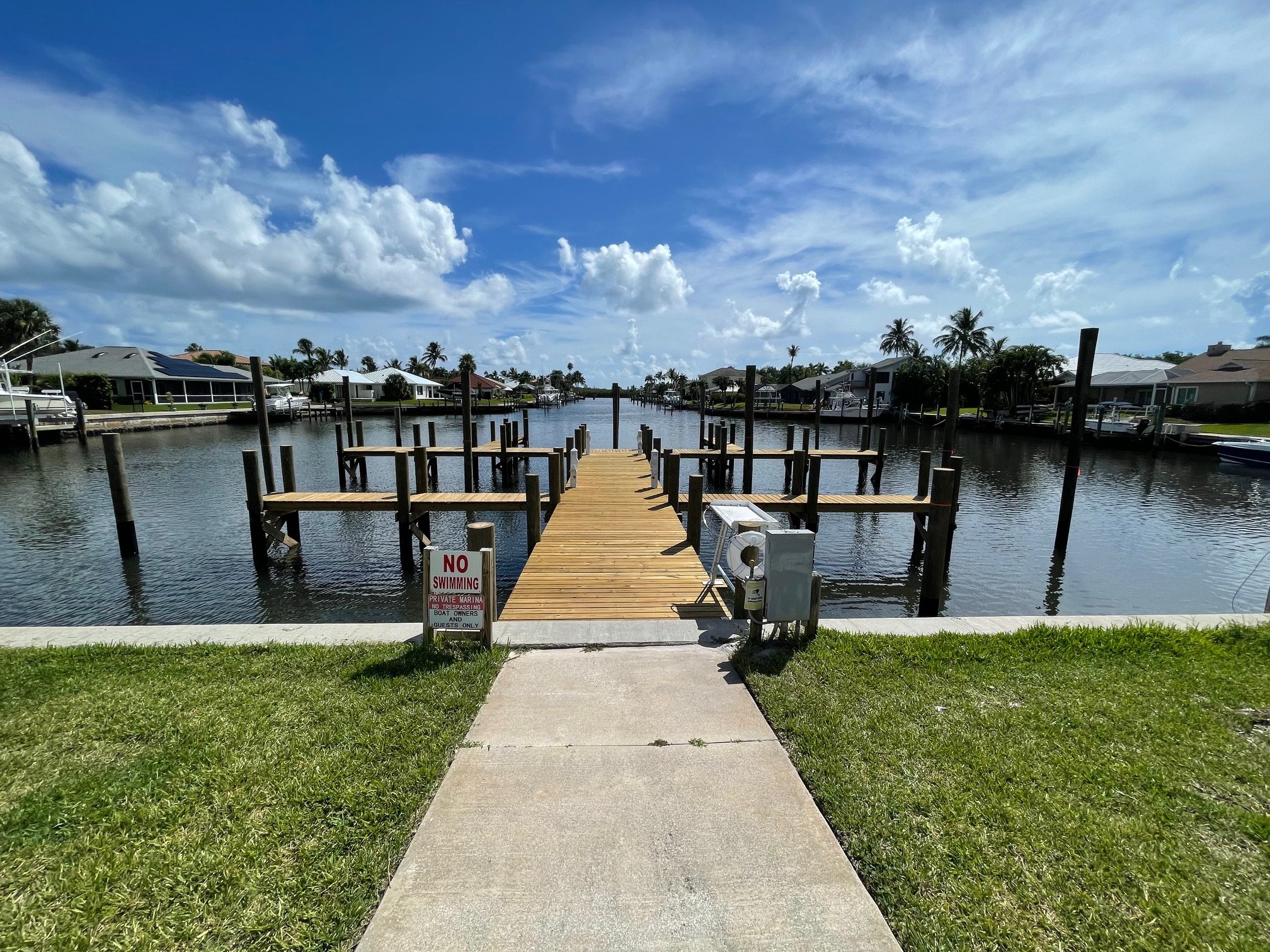
Composite vs. Wood Dock Decking — What's Best for South Florida?
Should you choose composite or wood dock decking for your South Florida waterfront property? Compare durability, maintenance, lifespan, appearance, and long-term value to make the best decision for your dock investment.
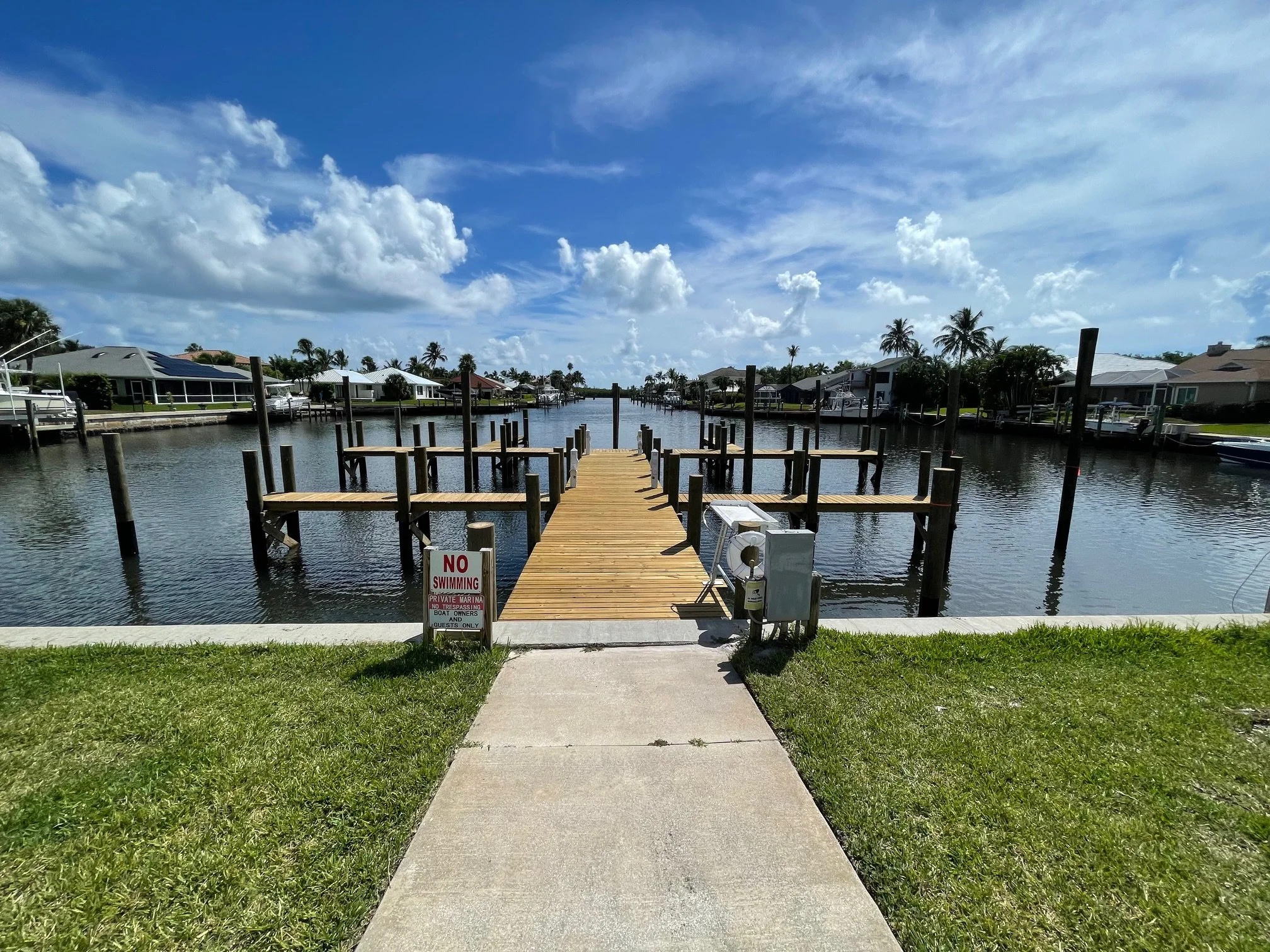
Composite dock decking provides a durable, low-maintenance alternative to traditional wood decking for South Florida waterfront properties. Designed to withstand sun exposure, moisture, and harsh marine conditions, composite decking is a popular choice for modern dock construction projects.
If you're planning a new dock or deck replacement in South Florida, one of the biggest decisions you'll make is choosing between composite and wood decking. Both have their place — but in South Florida's saltwater environment, the answer is almost always the same. Here is the full breakdown from the team at JKT Marine Construction.
Quick Comparison — Composite vs. Wood Dock Decking
Composite and PVC decking — Higher upfront cost of $18 to $35 per square foot, lasts 25 to 50 plus years, virtually no maintenance, no splinters, excellent slip resistance, excellent UV resistance, excellent salt and moisture resistance, superior long-term value. Recommended for South Florida.
Pressure-treated wood — Lower upfront cost of $10 to $20 per square foot, lasts 10 to 20 years, requires regular sealing and staining, splinters as it ages, good slip resistance when new but poor when wet or old, poor UV resistance, grays and cracks, higher ongoing costs over time.
Composite and PVC Decking — Recommended for South Florida
Composite decking is made from a blend of wood fiber and recycled plastic. PVC decking is made entirely from plastic with no wood content. Both are engineered specifically to resist the conditions that destroy traditional wood in marine environments.
Why composite and PVC win in South Florida. Unlike wood, composite and PVC don't absorb water, swell, rot, or delaminate in South Florida's marine environment. South Florida's intense sun grays and cracks wood within years — quality composite holds its color for decades. There are no splinters, which is critical for families with children and for bare feet on a dock. Most composite products have textured surfaces that maintain grip when wet. An occasional rinse is all composite needs — no sealing, staining, or pressure washing required. Quality composite installed today will still be performing well in 2060.
Popular Composite Brands We Install
Trex — The industry leader. Excellent fade resistance and 25-year warranty.
Fiberon — Strong marine-grade performance, competitive pricing.
TimberTech / AZEK — Premium PVC option, outstanding UV and moisture resistance.
WearDeck — 100% polymer decking engineered specifically for marine and waterfront applications. Extremely resistant to saltwater, UV, mold, and mildew. One of the best options available for South Florida docks.
Ipe composite — Tropical hardwood look without the maintenance.
Pressure-Treated Wood Decking
Pressure-treated wood has been the traditional choice for dock decking for decades. It is still a legitimate option in certain situations but comes with real limitations in South Florida's environment.
Where wood still makes sense. Budget-constrained projects where upfront cost is the primary concern. Temporary docks or structures with a limited expected lifespan. Commercial applications where decking is replaced on a regular maintenance schedule.
Limitations in South Florida. Requires sealing or staining every one to three years. Grays, cracks, and warps from UV exposure within a few years without maintenance. Splinters develop as wood ages — a hazard on a dock. Shorter lifespan means higher total cost of ownership over 20 to 30 years. Chemical treatments leach into the water over time.
The Real Cost Comparison Over 20 Years
Here is where the math gets interesting. For an 800 square foot dock, composite costs roughly $28,000 to install with about $500 in maintenance over 20 years and no replacement needed — total 20-year cost around $28,500. Pressure-treated wood costs roughly $16,000 to install but requires $8,000 or more in maintenance and a full replacement at year 15 to 20 costing another $16,000 — total 20-year cost around $40,000 or more. Composite wins on total cost of ownership every time.
JKT Marine's Recommendation
For virtually every South Florida waterfront homeowner, composite or PVC decking is the right choice. The combination of durability, low maintenance, safety, and long-term value makes it the clear winner in our saltwater environment. We only install marine-grade materials on every project — and we would never recommend a product we would not put on our own dock.
Ready to Replace Your Dock Decking?
JKT Marine Construction handles full deck replacements throughout Palm Beach and Broward County. Marine-grade composite and PVC only. Free estimates, no pressure. Call (561) 418-0383 or email info@jktmarine.com.
Frequently Asked Questions
How long does composite decking last on a dock in South Florida? Quality composite decking lasts 25 to 50 years in South Florida's marine environment with minimal maintenance. Most premium brands carry 25-year warranties against fading and staining.
Can composite decking get hot in South Florida's sun? Yes — dark-colored composite can get warm in direct sun, just like any surface. Lighter colors stay cooler. Most homeowners find this manageable given the other benefits composite provides over wood.
How much does dock deck replacement cost in South Florida? Dock deck replacement typically ranges from $10,000 to $40,000 or more depending on dock size and materials. JKT Marine provides free on-site estimates with transparent pricing.
Is composite decking slippery when wet? Quality composite products have textured surfaces designed to maintain grip when wet. This is actually one of the advantages composite has over aged wood, which becomes very slippery when wet.

How to Choose a Marine Contractor in South Florida — 7 Things to Look For
Choosing the right marine contractor can make the difference between a successful waterfront project and costly repairs. Learn the seven most important factors South Florida homeowners should consider before hiring a contractor for docks, seawalls, boat lifts, and marine construction projects.

Hiring the wrong marine contractor in South Florida is an expensive mistake. Dock construction, seawall repair, and boat lift installation are significant investments — and the quality of the contractor you hire determines whether your project is built to last or falls apart in a few years. Here is exactly what to look for before you sign any contract.
1. Verify Their Florida Contractor License
This is non-negotiable. Any marine contractor doing structural work in Florida must hold a valid state contractor license. You can verify any contractor's license for free at the Florida Department of Business and Professional Regulation website at myfloridalicense.com. Search the contractor's name or license number and confirm it is active and in good standing.
Ask for the license number before you go any further in the conversation. A legitimate contractor will give it to you immediately. JKT Marine Construction's license number is CGC1537758 — you can verify it right now.
Red flag — Any contractor who cannot immediately provide a Florida contractor license number or who asks you to pull permits yourself should be avoided entirely. Unpermitted marine construction can result in fines, required demolition, and serious complications when selling your property.
2. Confirm They Are Fully Insured
Marine construction is inherently risky work performed near and over water. Your contractor must carry both general liability insurance and workers compensation insurance. Ask for certificates of insurance before any work begins. If a worker is injured on your property and the contractor does not have workers comp, you could be liable.
3. Ask Who Actually Does the Work
Many marine contractors in South Florida are primarily salespeople who subcontract the actual construction to whoever is available. This means the people building your dock may have no relationship with the company you hired, no accountability to you, and no investment in quality. Always ask directly — do you use subcontractors, or does your own crew do the work?
At JKT Marine Construction, our answer is always the same. Our experienced crew handles everything including pile driving, construction, electrical, and finishing. Owner Trevor is personally on every job site.
4. Check That They Handle All Permitting
Dock construction, seawall work, and boat lift installation in South Florida require permits from multiple agencies including local building departments, SFWMD, FDEP, and in many cases the Army Corps of Engineers. A contractor who tells you permitting is your responsibility or who suggests building without permits is a major red flag.
An experienced marine contractor handles all permitting in-house and is familiar with the specific requirements of Palm Beach County, Broward County, and Martin County. This protects you legally and ensures the work is done to code.
5. Read Google Reviews — Especially the Recent Ones
Do not just look at the star rating — read the actual reviews. Look for mentions of communication during the project, whether they showed up when they said they would, how they handled problems, and the quality of the finished work. Pay attention to reviews from the last 12 months, not just the overall average.
Also check if the contractor responds to their reviews. A contractor who takes the time to reply to customers is one who cares about their reputation. JKT Marine Construction currently holds a 5-star rating on Google with reviews from real South Florida waterfront homeowners.
6. Get a Written Itemized Estimate
Any legitimate marine contractor will provide a written estimate that clearly breaks down materials, labor, and permitting costs. Be very cautious of vague estimates or contractors who give prices verbally without putting anything in writing. Your contract should clearly specify the exact scope of work, materials to be used including brand type and grade, project timeline, payment schedule, what is included in permitting, and warranty terms.
7. Ask About Local Water Knowledge
South Florida's waterways have specific characteristics that affect how marine construction is done. Tidal patterns on the Intracoastal, soil conditions from soft muck to hard limestone, manatee protection zones, and hurricane load requirements all matter. A contractor who works primarily in another region of Florida may not understand these local nuances.
Ask how long they have been working in your specific area and whether they are familiar with the waterway conditions on your property. The right contractor will ask you specific questions about your water depth, tidal range, and existing structures — not just give you a generic quote.
JKT Marine Construction Checklist
Licensed CGC1537758
Fully insured with liability and workers comp coverage
No subcontractors — our own crew on every job
All permits handled including SFWMD, FDEP, and Army Corps
5-star Google rated
Owner Trevor personally on every job site
South Florida specialists serving Palm Beach, Broward, and Martin County
Questions to Ask Before You Hire Any Marine Contractor
What is your Florida contractor license number?
Can you provide certificates of liability and workers comp insurance?
Do you use subcontractors or does your own crew do the work?
Will you handle all permits including SFWMD, FDEP, and Army Corps if needed?
Can I see examples of similar projects you have completed in my area?
What materials do you use and why?
What is your payment schedule?
What warranty do you provide on your work?
Talk to JKT Marine Construction
Licensed CGC1537758. Fully insured. No subcontractors. Owner on every job site. Free estimates throughout Palm Beach, Broward and Martin County. Call (561) 418-0383 or email info@jktmarine.com.
Frequently Asked Questions
How do I verify a contractor's license in Florida? Go to myfloridalicense.com and search the contractor's name or license number. You can verify the license is active, check for any disciplinary actions, and confirm the contractor's insurance information.
What happens if a marine contractor builds without permits? Unpermitted marine construction can result in fines from the county, orders to remove the structure, and serious complications when selling your property. Always insist on proper permitting regardless of what a contractor tells you about saving time or money.
How many estimates should I get for a dock or seawall project? We recommend getting two to three estimates for any marine construction project. Be cautious of the lowest bid — marine construction quality varies enormously and the cheapest option often means inferior materials, unlicensed workers, or work done without permits.
Is JKT Marine Construction licensed and insured? Yes. JKT Marine Construction holds Florida contractor license CGC1537758, carries full general liability insurance, and maintains workers compensation coverage on all employees. You can verify our license at myfloridalicense.com.
How Much Does Seawall Repair Cost in South Florida? (2026 Guide)
If you're a waterfront homeowner in Palm Beach County or Broward County noticing cracks, leaning panels, or erosion behind your seawall, you're probably wondering how much seawall repair costs in South Florida. This 2026 guide gives you real cost ranges based on what we actually see in the field every day at JKT Marine Construction.
Average Seawall Repair Costs in South Florida (2026)
Crack injection and sealing: $2,000 – $8,000
Seawall cap replacement: $5,000 – $15,000
Tieback anchor installation: $8,000 – $20,000
Partial seawall repair: $5,000 – $30,000
Full concrete seawall replacement: $20,000 – $150,000+
Vinyl sheet pile seawall: $15,000 – $100,000+
Riprap/revetment installation: $10,000 – $50,000+
Early repair is almost always less expensive than full replacement — which is why a free assessment matters.
Signs Your Seawall Needs Repair
Visible cracks or fractures in the seawall face
Leaning or tilting panels
Soil erosion or sinkholes behind the wall
Rust staining from corroding rebar
Water seeping through the wall during high tide
Cracking or separating cap along the top
What Factors Affect Seawall Repair Cost?
Linear footage is the biggest cost driver. A 50-foot seawall costs significantly less than a 200-foot seawall. Most residential seawalls in Palm Beach and Broward County run 50 to 150 linear feet.
Severity of damage matters too. Localized cracks caught early can often be repaired for a few thousand dollars. A seawall neglected for years may require full replacement. Early action almost always saves money.
Permitting adds $1,500 to $6,000 depending on scope. Seawall work requires permits from local building departments and often SFWMD, FDEP, and Army Corps of Engineers. JKT Marine handles all permitting in-house — you never deal with agencies directly.
Repair vs. Replace
At JKT Marine, our rule is simple: repair when possible, replace when necessary. We never recommend full replacement just to increase a job's value. Signs replacement is necessary include multiple panels failing, seawall exceeding its 30 to 50 year lifespan, or repair costs exceeding 70% of replacement cost.
How Long Does Seawall Repair Take?
Permitting takes 2 to 6 weeks. Localized repairs take 1 to 3 days on site. Full replacement takes 1 to 3 weeks on site. Total timeline is typically 4 to 10 weeks from contract to completion.
Get a Free Seawall Assessment
JKT Marine Construction offers free seawall inspections throughout Palm Beach and Broward County. We give you an honest recommendation — repair when possible, replace when necessary. No overselling, no pressure. Call (561) 418-0383 or email info@jktmarine.com.
Frequently Asked Questions
Do I need a permit to repair my seawall in Florida? Yes. All seawall repairs require permits. JKT Marine handles all permitting on your behalf.
How long does a seawall last in South Florida? A properly built concrete seawall lasts 30 to 50 years. Vinyl and composite seawalls can last 50 or more years.
What happens if I ignore a cracked seawall? Small cracks allow water to erode the soil behind the wall. What costs $5,000 to fix today can cost $80,000 or more if left unaddressed for a few years.
Can seawalls be repaired without full replacement? Yes in many cases. Crack injection, cap replacement, and tieback anchors can extend a seawall's life by 10 to 20 years at a fraction of replacement cost.
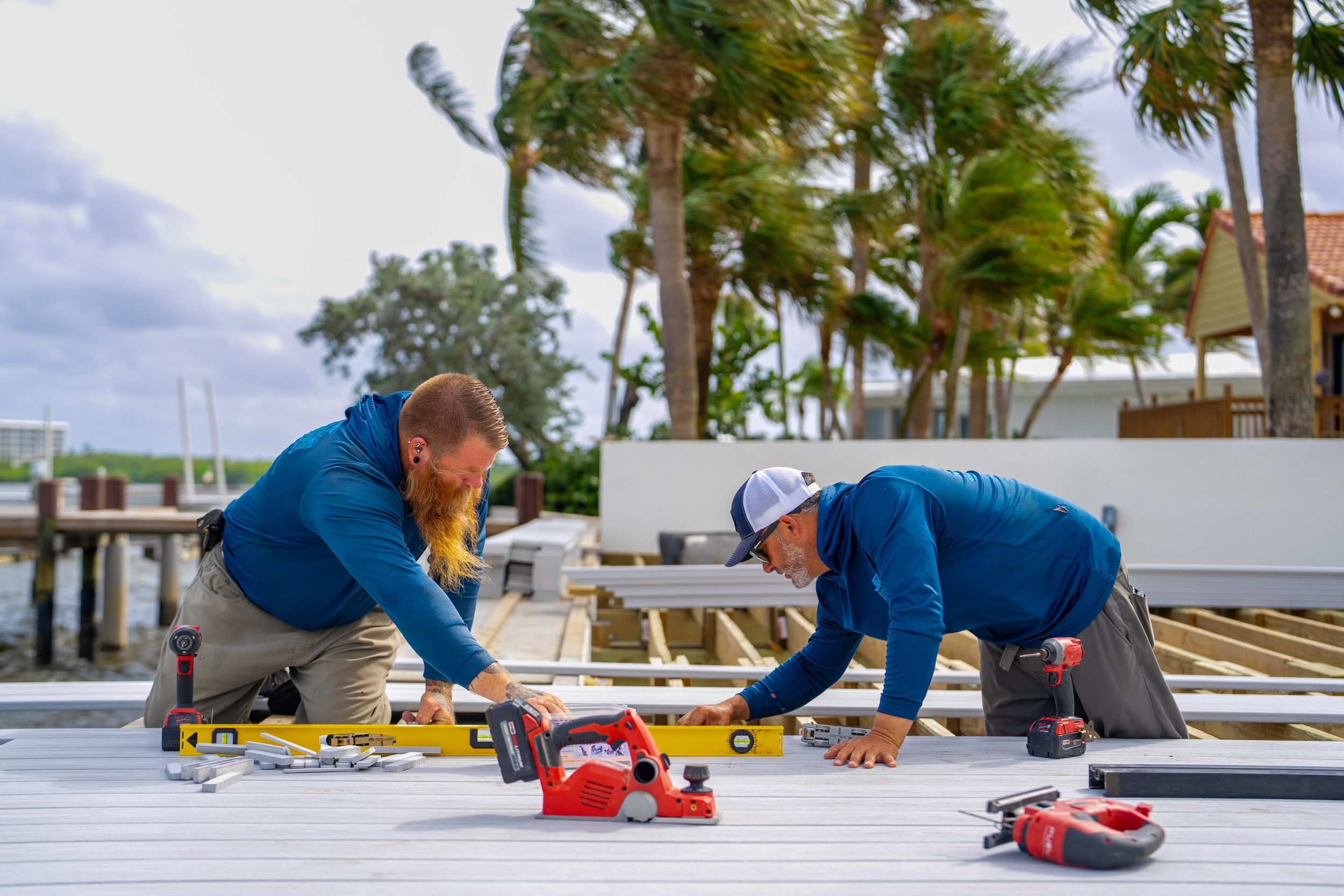
How Much Does Dock Construction Cost in South Florida? (2026 Guide)
Dock construction costs in South Florida vary based on dock size, materials, water depth, permitting requirements, and site conditions. Learn what impacts pricing and what waterfront homeowners can expect when budgeting for a new dock or dock replacement project.
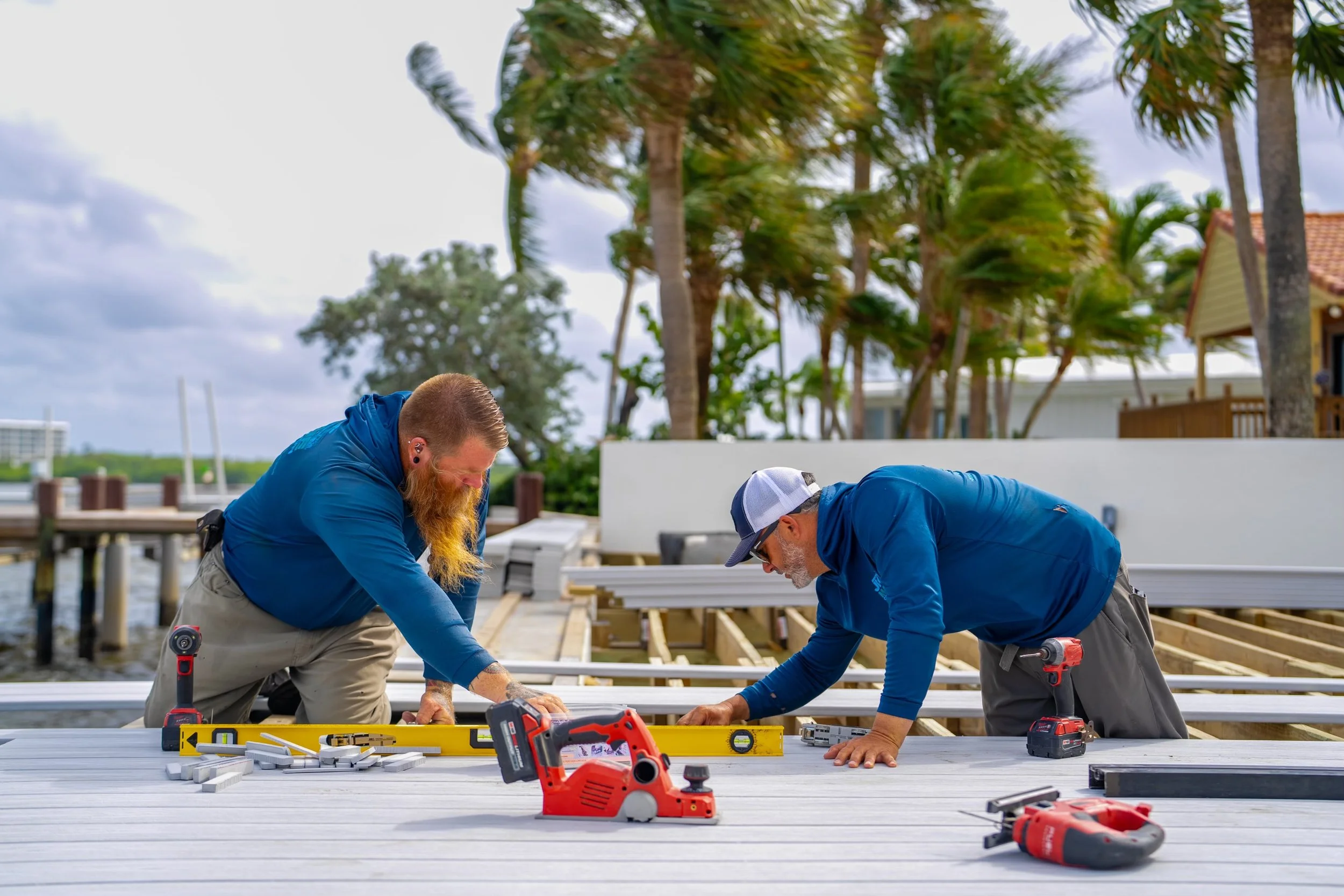
Dock construction costs depend on several factors including dock size, piling requirements, decking materials, permit costs, water conditions, and site access. Understanding these variables helps South Florida waterfront homeowners accurately budget for a new dock construction project.
If you are a waterfront homeowner in South Florida planning a new dock or replacing an existing one, the first question on your mind is almost always the same — how much is this going to cost? The honest answer is that dock construction costs in South Florida vary widely depending on size, materials, water depth, and permitting requirements. This 2026 guide gives you real cost ranges based on what JKT Marine sees every day throughout Palm Beach County and Broward County.
WHAT AFFECTS DOCK CONSTRUCTION COST IN SOUTH FLORIDA?
Before getting into specific numbers, it helps to understand what drives dock construction costs in our area. South Florida is not a simple market for marine construction. Permitting requirements, saltwater conditions, tidal range, and waterway regulations all affect what a dock costs to build here compared to other parts of the country.
The main factors that affect your dock construction cost are:
— Dock size and configuration — length, width, and whether you need a finger pier, T-head, or L-head
— Material choice — composite, PVC, or pressure-treated lumber for decking, concrete or wood pilings
— Water depth — deeper water requires longer pilings which increases cost
— Number of pilings required — more pilings means more pile driving time and materials
— Permitting complexity — Intracoastal properties require more agency approvals than interior canals
— Boat lift integration — adding a boat lift during dock construction versus separately
— Site access — barge access, overhead obstacles, and canal width all affect installation cost
— Existing structure removal — if an old dock needs to be demolished before the new one is built
DOCK CONSTRUCTION COST RANGES IN SOUTH FLORIDA (2026)
Basic dock redeck only — $8,000 to $20,000
Replacing the surface of an existing structurally sound dock with composite or PVC decking. One of the most common and cost-effective dock improvements in South Florida.
New small residential dock — $20,000 to $40,000
A straightforward new dock build on a protected residential canal with standard water depth and good site access. Composite decking, pressure-treated or concrete pilings, basic configuration.
New mid-size residential dock — $40,000 to $75,000
A larger dock with more pilings, wider decking, and additional features like a T-head or finger pier. May include boat lift blocking or basic electrical.
New large or Intracoastal dock — $75,000 to $150,000+
Intracoastal Waterway properties, deep water installations, complex configurations, or docks requiring barge access for pile driving. Multi-agency permitting adds both time and cost.
Commercial or marina dock — $150,000+
Commercial-grade construction with heavy-duty materials, higher load ratings, and complex permitting. Pricing varies significantly based on scope.
MATERIAL COSTS FOR SOUTH FLORIDA DOCKS
Composite decking — $18 to $35 per square foot installed. Our top recommendation for South Florida. Lasts 25 to 50 years with minimal maintenance. No sealing, no staining, no splinters.
PVC decking — $20 to $40 per square foot installed. The most moisture-resistant option available. Completely immune to rot and saltwater absorption.
Pressure-treated lumber — $12 to $20 per square foot installed. The most affordable option but requires sealing every 1 to 3 years and lasts 10 to 15 years in South Florida conditions.
Concrete pilings — $800 to $1,500 per piling installed. Our preferred choice for longevity. Not susceptible to marine boring organisms. Lasts 50 or more years.
Composite pilings — $600 to $1,200 per piling installed. Excellent corrosion resistance with lighter weight than concrete.
Pressure-treated wood pilings — $400 to $800 per piling installed. Lower upfront cost but vulnerable to shipworms and rot over time in South Florida waterways. Typical lifespan 15 to 25 years.
PERMITTING COSTS FOR SOUTH FLORIDA DOCKS
Permitting is a real cost that many homeowners do not factor in when budgeting for dock construction. In Palm Beach County and Broward County, dock permits typically cost $1,500 to $5,000 in agency fees depending on project scope and which agencies are involved.
Standard canal dock — Palm Beach County or Broward County building permit plus SFWMD review. Typically 6 to 10 weeks processing time.
Intracoastal Waterway dock — County permit plus SFWMD plus Army Corps of Engineers. Typically 10 to 16 weeks processing time. Higher permit fees.
JKT Marine manages all permit filings in-house on every project. You never contact a government agency directly — we handle everything from application through final inspection.
HOW LONG DOES DOCK CONSTRUCTION TAKE?
Permitting is the longest part of any dock project in South Florida. Here is a realistic timeline:
Week 1 — Site visit, quote approval, permit application submitted
Weeks 2 through 8 — Permitting review period
Week 8 to 10 — Permits approved, materials ordered, construction scheduled
Construction — 1 to 2 weeks for most residential docks depending on size and complexity
Total from first call to finished dock — plan on 10 to 14 weeks for a standard project. Intracoastal and complex projects may run 16 to 20 weeks due to additional agency review.
REPAIR VS NEW CONSTRUCTION — HOW TO DECIDE
If your existing dock has sound pilings and structural framing, a redeck is almost always the most cost-effective path. You get a brand new surface and a fresh 25 to 50-year lifespan on the decking for a fraction of full replacement cost.
If your pilings are failing, your framing is structurally compromised, or damage is widespread throughout every component — full replacement is often more economical long-term than a series of piecemeal repairs over several years.
JKT Marine assesses every dock honestly before making any recommendation. If repair will solve the problem, that is what we tell you.
GET A FREE DOCK CONSTRUCTION ESTIMATE
JKT Marine Construction builds and repairs docks throughout Palm Beach County, Broward County, and Martin County. Free on-site estimates, all permits handled, marine-grade materials throughout.
Call us at (561) 418-0383 or email photos of your waterfront to info@jktmarine.com and we will get back to you fast with a real number.
Licensed CGC1537758 · Fully Insured · Family-Owned · Free Estimates
FREQUENTLY ASKED QUESTIONS
How much does it cost to build a dock in Palm Beach County?
A new residential dock in Palm Beach County typically runs $20,000 to $75,000 depending on size, materials, and water depth. Intracoastal properties and larger docks run higher. JKT Marine provides free on-site estimates throughout Palm Beach County.
Do I need a permit to build a dock in South Florida?
Yes — all new dock construction in South Florida requires permits. Depending on your location you may need Palm Beach County or Broward County building permits, SFWMD approval, and Army Corps of Engineers authorization. JKT Marine handles all permit filings in-house.
How long does a new dock last in South Florida?
A well-built dock with composite decking and concrete pilings lasts 40 to 50 years or more in South Florida. Pressure-treated wood decking lasts 10 to 15 years. Concrete and composite pilings outlast pressure-treated wood pilings significantly in South Florida's marine environment.
What is the best decking material for a South Florida dock?
Marine-grade composite decking is our top recommendation for South Florida. It resists saltwater, UV radiation, and moisture without requiring sealing or staining. Brands like WearDeck, Trex, and TimberTech AZEK perform very well in our environment.
How do I get a dock construction quote from JKT Marine?
Call us at (561) 418-0383 or email photos of your waterfront to info@jktmarine.com. We come out to your property, assess the site, and give you a written quote with no obligation.