
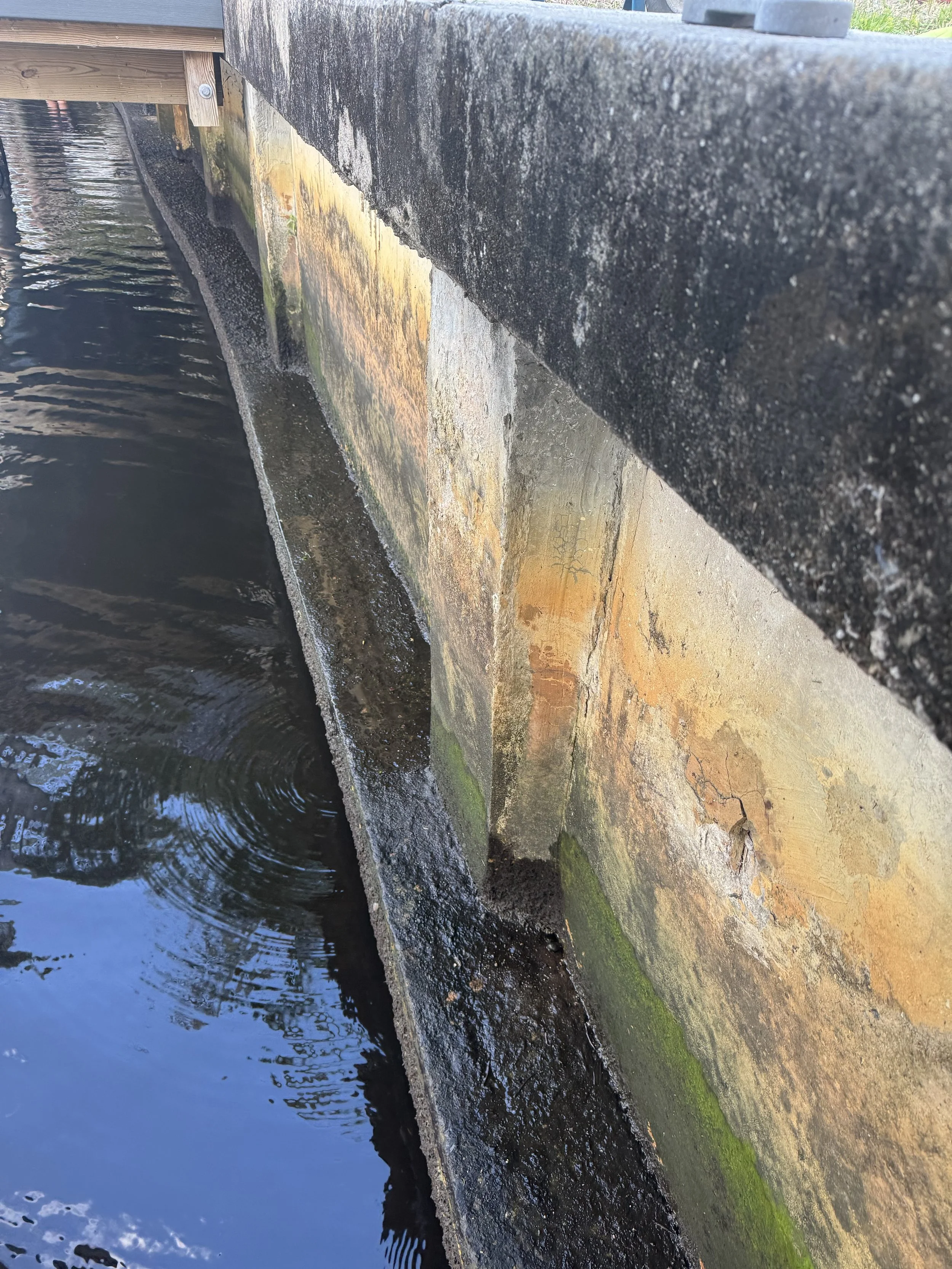
Seawalls exposed to South Florida’s marine environment often develop algae, marine growth, staining, and organic buildup over time. Regular seawall cleaning helps maintain appearance, identify potential issues early, and extend the life of waterfront structures.
Seawall Cleaning and Maintenance Guide for South Florida Homeowners
Ask most South Florida waterfront homeowners when they last had their seawall professionally cleaned and maintained and the answer is almost always the same — never, or not recently. It is understandable. A seawall that is not visibly failing tends to get overlooked in favor of the dock, the boat lift, and the landscaping that are more immediately visible from the property.
But here is the reality that JKT Marine's ownership team sees consistently throughout Palm Beach County and Broward County — the seawalls that need the most expensive emergency repairs are almost always the ones that received no routine maintenance. And the seawalls that reach 40 or 50 years of service life in sound structural condition are almost always the ones where a homeowner paid attention to basic maintenance along the way.
This guide explains exactly what professional seawall cleaning and maintenance involves, how often it should be scheduled in South Florida's specific environment, and what it prevents over the service life of your wall.
Why South Florida Is Harder on Seawalls Than Almost Anywhere Else
Before getting into what maintenance involves, it helps to understand why seawall maintenance matters so much more in South Florida than in most other coastal regions.
Saltwater exposure is constant and year-round. South Florida's tidal canals, Intracoastal Waterway, and coastal waterways expose seawalls to saltwater chemistry 24 hours a day, 365 days a year. Salt infiltrates concrete surfaces, accelerates steel corrosion, and degrades exposed hardware at a rate that inland or freshwater environments simply do not produce.
Biological growth is aggressive and fast. Barnacles, algae, and other marine organisms attach to seawall surfaces within weeks of installation in South Florida's warm water. Left unchecked, this growth traps moisture against the concrete surface, creates conditions that accelerate crack formation, and provides a pathway for saltwater infiltration into the concrete matrix.
UV radiation is intense. South Florida's solar exposure degrades concrete sealers, accelerates surface weathering, and drives the thermal expansion and contraction cycles that widen hairline cracks over time. Maintenance intervals that are adequate in northern climates are often insufficient in South Florida's solar environment.
Tidal cycling creates continuous drainage demands. South Florida's tidal waterways move water in and out of canal systems continuously — and that movement deposits sediment and biological debris into seawall drainage points with every tidal cycle. Blocked drainage is one of the most common and most preventable causes of accelerated seawall deterioration throughout Palm Beach and Broward County.
What Professional Seawall Cleaning and Maintenance Includes
Professional seawall maintenance is meaningfully different from hosing down the dock or running a pressure washer along the wall face on a Saturday morning. Here is exactly what a proper maintenance visit from JKT Marine covers.
Surface cleaning and marine growth removal
We begin every maintenance visit with a thorough pressure washing of the full seawall face — removing barnacles, algae, calcium deposits, and biological growth from the wall surface using professional pressure washing equipment and marine-safe cleaning solutions that will not harm the canal ecosystem, your dock hardware, or the seawall material itself.
A clean seawall surface is not just aesthetic. It allows proper visual inspection of the concrete face for developing cracks and deterioration that are hidden under biological growth. It removes the moisture-trapping biological layer that accelerates surface concrete deterioration. And it eliminates the foothold that marine growth uses to work its way into hairline cracks and joint gaps over time.
Weep hole and drainage system clearing
Every weep hole and jet filter drainage point in the seawall is cleared of sediment, debris, and biological blockage and tested for proper water flow. Drainage points that are missing, damaged, or structurally compromised are flagged for repair or replacement.
This step is one of the most important in the entire maintenance process. Blocked drainage is a silent structural threat — it builds hydrostatic pressure behind the wall that actively pushes panels outward over time and is one of the leading causes of seawall leaning and failure throughout South Florida's canal communities.
Structural condition walkthrough
With the wall surface clean and the drainage system cleared, our team walks the full length of the seawall and conducts a detailed structural assessment — noting crack location and size, cap condition, any visible changes in panel alignment, tie rod corrosion indicators, soil erosion signs behind the wall, and cap elevation relative to current county standards.
The clean wall surface after pressure washing allows us to see hairline cracks and early-stage surface deterioration that would be invisible beneath the layer of biological growth present on an unmaintained wall. This is why professional cleaning and structural assessment go together — you cannot effectively assess a dirty seawall.
Crack sealing and joint treatment
Hairline cracks and panel joint gaps identified during the structural walkthrough are sealed with marine-grade flexible sealant before water infiltration can reach the internal rebar and tieback rod connections behind the concrete. This is the most cost-effective structural intervention available in seawall maintenance — sealing a hairline crack during a routine maintenance visit costs a small fraction of what that same crack costs to address after it has allowed rebar corrosion to begin.
Concrete sealing and surface treatment
We apply marine-grade concrete sealer to the cleaned seawall surface — creating a protective barrier against saltwater infiltration, UV degradation, and the salt crystal expansion that widens hairline cracks over time. Concrete sealing significantly slows the primary deterioration mechanism affecting concrete seawalls in South Florida's environment and is one of the highest-return preventive maintenance steps available to waterfront homeowners.
Written condition report
Every JKT Marine maintenance visit concludes with a written condition report delivered to you covering the current structural status of every wall component, any issues identified during the visit and their recommended treatment, and a timeline for follow-up work if any is needed. You always leave a maintenance visit knowing exactly where your seawall stands structurally.
How Often Should a Seawall Be Professionally Maintained in South Florida?
The right maintenance interval depends on your wall's age, material, and waterway exposure. Here is what JKT Marine recommends based on our field experience throughout Palm Beach County and Broward County.
Vinyl seawalls under 20 years old in protected residential canals
Annual cleaning and inspection is appropriate for most vinyl seawalls in this category. The primary maintenance needs are drainage clearing and structural inspection — vinyl's corrosion resistance means the surface treatment work required for concrete is not a factor, but drainage and structural monitoring remain important throughout the wall's service life.
Concrete seawalls under 25 years old
Annual professional cleaning, drainage clearing, and structural inspection — with concrete sealer application every 2 to 3 years and prompt crack sealing whenever hairline cracks are identified during inspection visits.
Concrete seawalls 25 to 40 years old
Semi-annual professional maintenance — once in spring before peak boating and storm season, and once in fall after hurricane season. Concrete sealer application annually. Prompt attention to any crack, cap, or drainage issue identified during visits.
Concrete seawalls over 40 years old
Annual professional inspection at minimum with semi-annual cleaning recommended. Walls in this age range in South Florida's environment are approaching or at the stage where restoration or replacement planning becomes relevant — regular professional assessment is the only reliable way to stay ahead of developing structural issues at this age.
Any seawall after a named storm or hurricane
A professional cleaning and inspection visit after any named storm event is recommended regardless of the wall's age or your regular maintenance schedule. Storm surge and wave loading stress seawall systems in ways that are not always visible from the surface, and post-storm debris commonly blocks drainage points that need to be cleared before the next tidal cycle.
What Regular Maintenance Prevents — and What It Costs to Skip It
The financial case for regular seawall maintenance in South Florida is straightforward. Here is how deferred maintenance compounds into significantly larger expense over time.
Skipping annual drainage clearing allows hydrostatic pressure to build behind the wall over months and years — eventually contributing to panel movement and structural failure that costs $15,000 to $50,000 to correct structurally, versus the cost of clearing drainage during a routine maintenance visit.
Skipping concrete sealing allows saltwater infiltration to reach internal rebar at an accelerated rate — compressing the timeline between hairline crack formation and structural rebar corrosion damage from years to months.
Skipping crack sealing during maintenance visits allows hairline cracks — which cost very little to seal when first identified — to become pathways for rebar corrosion that cost thousands to address once they have allowed internal damage to begin.
Skipping structural inspection allows developing problems to progress without detection — reaching the point where repair becomes more expensive or replacement becomes necessary when earlier identification would have allowed lower-cost intervention.
The pattern is consistent. Every dollar spent on routine seawall maintenance in South Florida prevents multiple dollars in repair costs that result from the deterioration that maintenance prevents. Annual professional maintenance for a South Florida seawall is not optional upkeep — it is the lowest-cost approach to seawall ownership available to waterfront homeowners in this environment.
JKT Marine Annual Seawall Maintenance Programs
JKT Marine Construction offers structured annual and semi-annual seawall maintenance programs for residential waterfront homeowners, HOAs, and marina operators throughout Palm Beach County, Broward County, and Martin County.
Our maintenance programs include full surface cleaning, drainage system clearing and testing, detailed structural inspection with written report, marine-grade concrete sealing, crack and joint sealing, and priority scheduling for any repair work identified during maintenance visits.
If your seawall has not been professionally cleaned and inspected in the past 12 months — or has never received professional maintenance — call JKT Marine to schedule a visit. We provide a free initial assessment and clearly explain what your specific wall needs based on its age, material, and waterway conditions.
Call (561) 418-0383 or email info@jktmarine.com.
JKT Marine Construction — Licensed CGC1537758 · Fully Insured · Family-Owned · All Permits Handled · Serving Palm Beach County, Broward County and Martin County